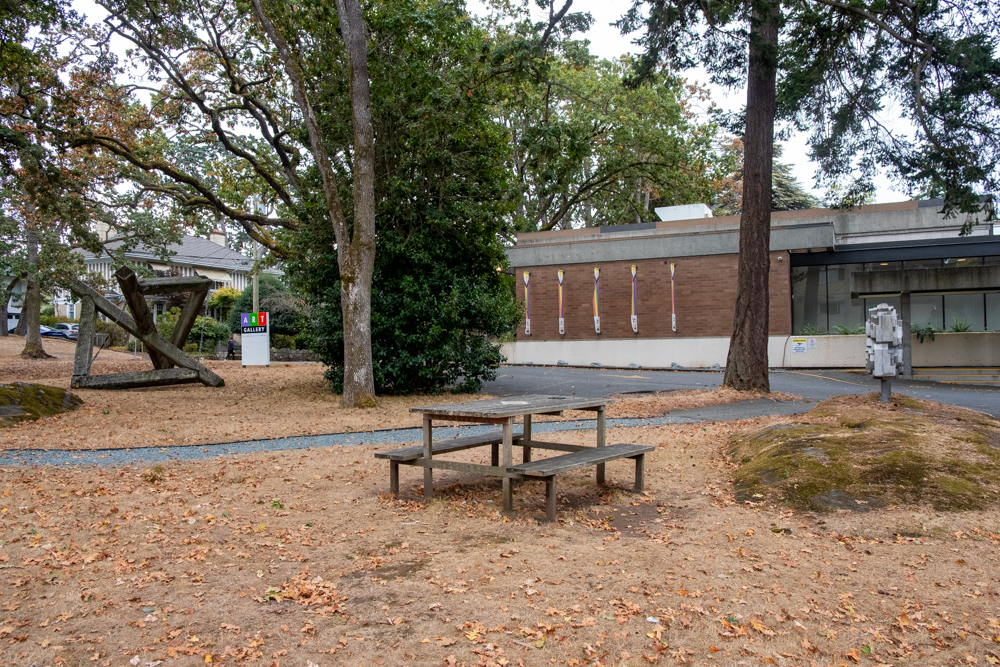
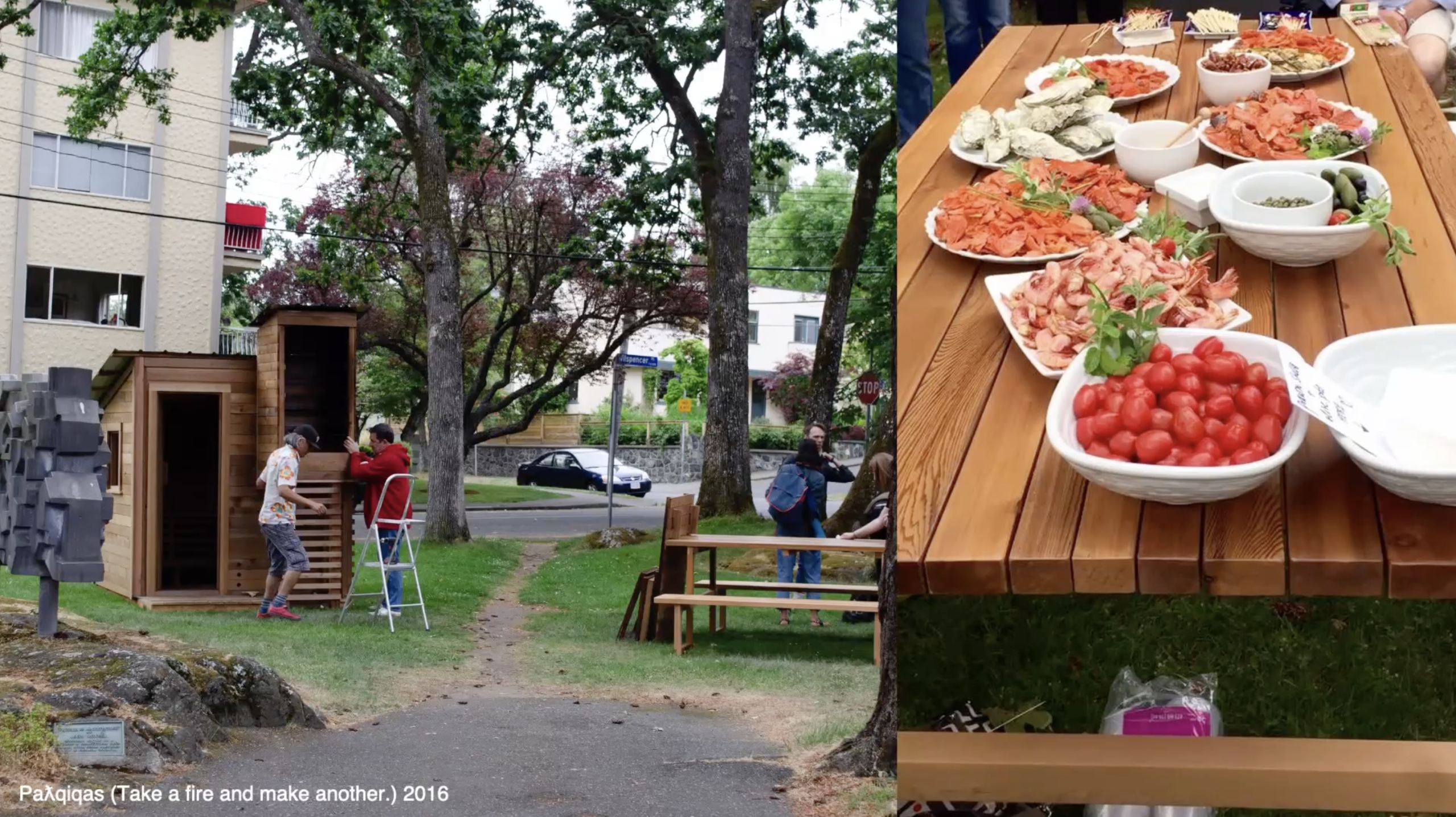
Curated by Michelle Jaques, the project was an invited intervention into Gwen MacGregor’s 2015 installation Circumference—itself a response to the exhibition Jock Macdonald: Evolving Form, a career survey that encompassed time Macdonald spent in the nuučaanuł territory of Nootka Sound. Drawing from this complex dialogue, Paƛšiʔaƛma merges local Indigenous and European traditions in a modular, composite structure that diverts smoke from a woodfired sauna into a smokehouse. A related day-long event, held in front of the Gallery, offered free sauna sessions and meals of smoked food that were shared on a bonus construction: a custom-built picnic table that has remained on site hosting spontaneous conversations and moments of rest ever since.
Working at a powerful intersection of urgency and irreverence, Emily and Rod’s practice incorporates varied cultural elements into artworks that are created within, and as, flexible collective spaces. These are core aspects of C.R.A.F.T. (Centre for Retrofitting and Failure Techniques) / qʷicčiƛma (the sky opened up), run by the artists in Ahswinnis / Port Alberni. Offering a print studio and an outdoor gathering space with a garden, stage, and firepit, as well as a digital component, C.R.A.F.T. has generated diverse projects ranging from print-making residencies and cedar bark rope making workshops, to a cross-disciplinary research gathering on the MV Frances Barkley, a working Alberni Inlet passenger and cargo ship. We’re grateful to Emily and Rod for taking the time to revisit their points of connection with AGGV over the years and share some insight into recent collaborations.
Questions are answered by Emily and Rod collectively.
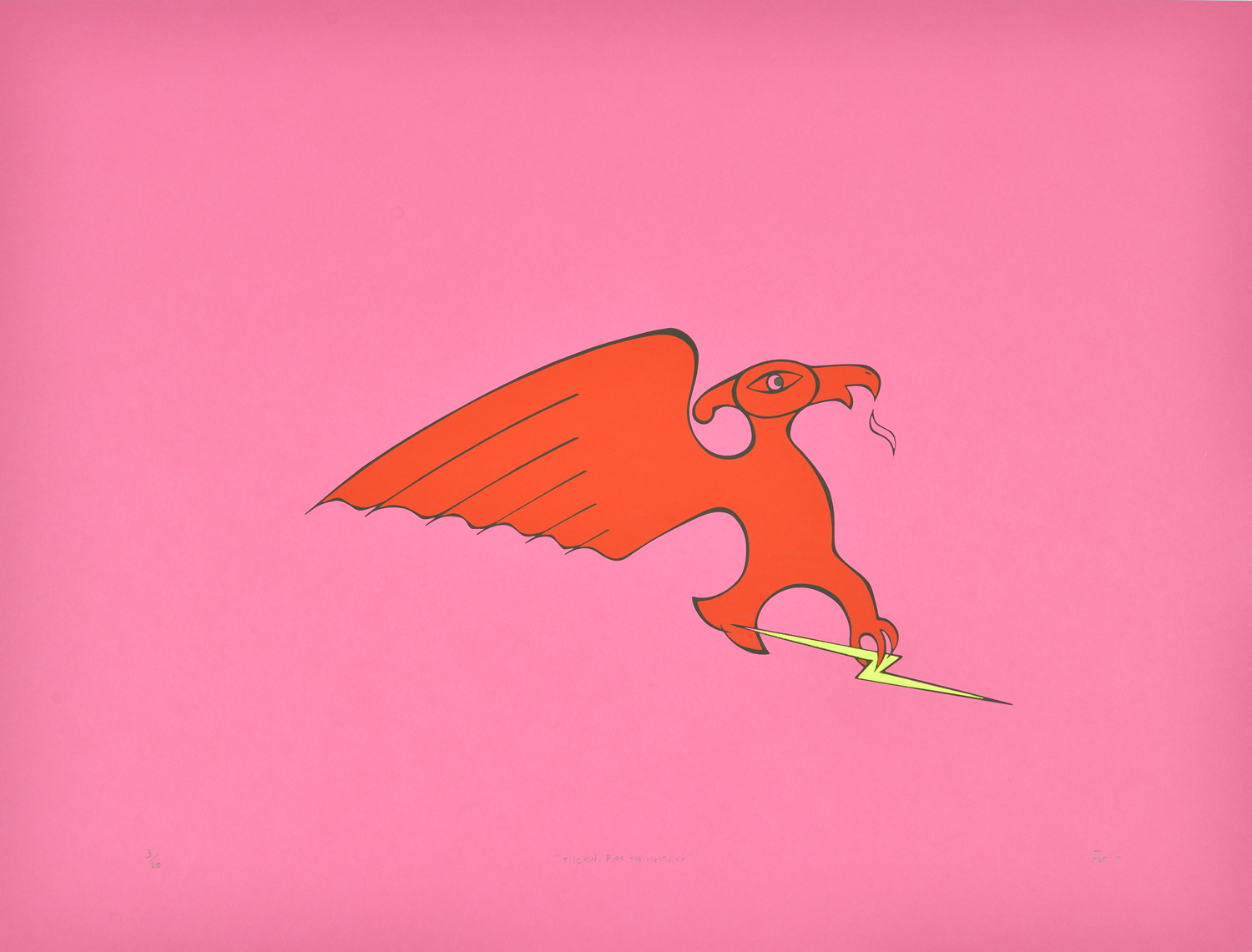
AGGV: Tiickin, Ride the Lightning is a striking example of how you work with what you’ve referred to as “the collision of worlds that exist.” What was on your mind while you were creating it? Were you listening to a lot of Metallica?
Emily Luce & Rodney Sayers: I’ll get this out of the way first. I only listen to Metallica when it comes on the airwaves. I’m more of a Led Zeppelin, Miles Davis listener.
Tiickin is the nuučaanuł Barclay dialect word for Thunderbird, a super natural that carries lightning snakes in its wings and feeds on whales. The thunderbird blinks its eye and the snakes turn into lightning bolts which stun the whale. It is a motif that comes to me from my maternal grandfather, and is an important figure in my work.
The collision of the natural and supernatural worlds happens constantly. If you watch the world closely, you can catch a glimpse of these collisions. This is one aspect of the “funny edge of the world” (borrowing from Castenada). I can imagine this bird flying there, and Em and I have witnessed it on more than one occasion.
Curator Michelle Jaques told me that a viewer of this piece asked her, “is he taking the piss out of us?” I thought that was an excellent response.
Would it be fair to say that you take fun seriously? Why is having fun an important part of art, and cultural conversations in general?
As you well know, the nuučaanuł are a very funny people.
I worked with the Fluent Speaker, Elder Advisors group of my community for many years doing language preservation. They took this urgent and heavy work very seriously, but also took laughter just as seriously. During one session, Tat was writing on the dry erase board and the pen stopped working. He said, “the pen has gone dry.” So I asked, “how do you say that in our language?” Aunty Jessie offered a response. An uproar of laughter. She was quiet for a moment, then offered another phrase. Another fit of laughter, louder this time. Another pause, she spoke another phrase, and the group was in tears with laughter. She obviously was not talking about a pen. It was a master stroke of comedy; her timing was perfect.
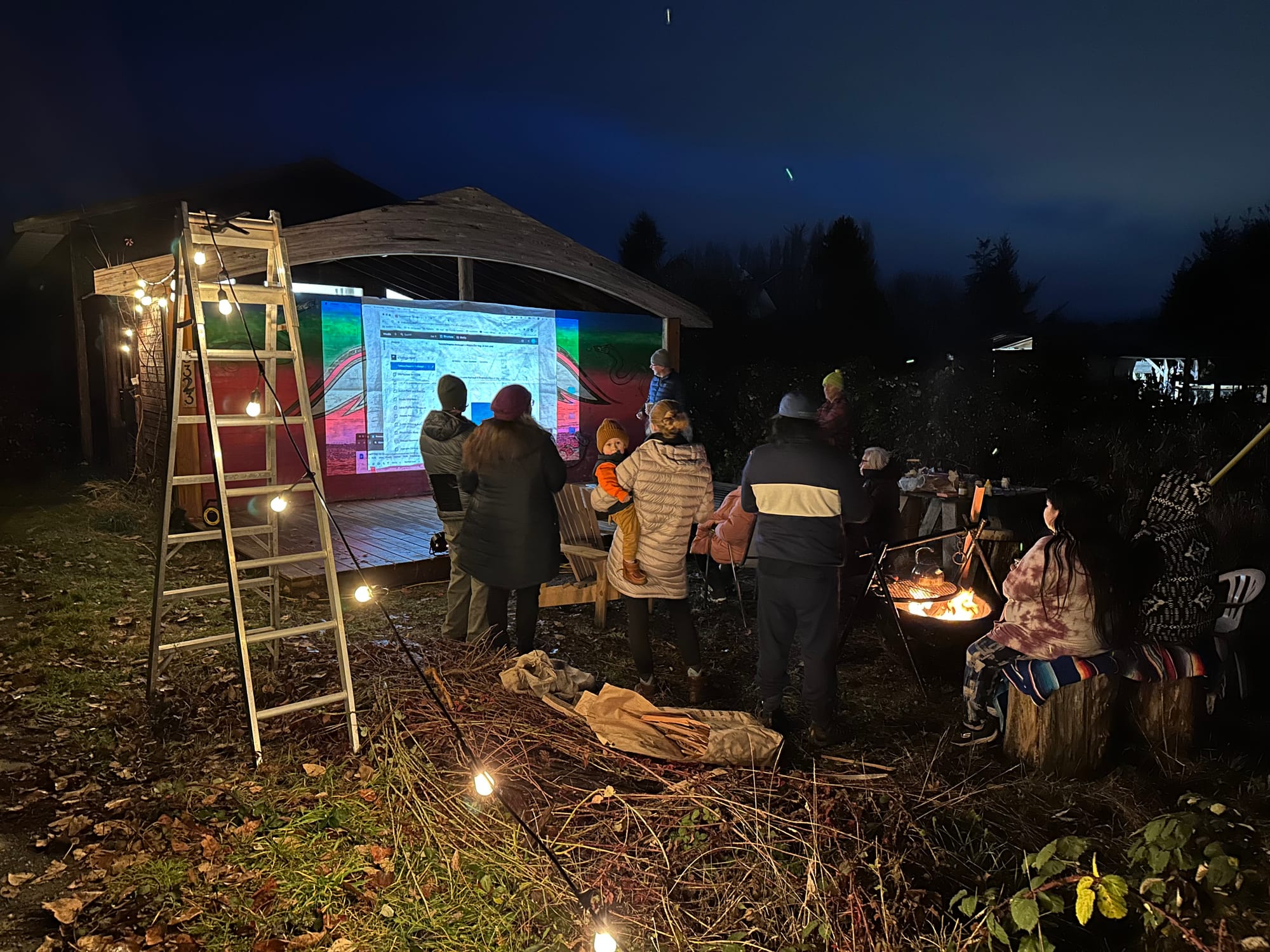
Having fun is an act of sovereignty and rebellion. It is a practice, and an artform. Everyone has the inherent right to self-determination, and comedy. This is a foundational aspect to the studio, and a big part of why advancements like the picnic table (which is a bigger version of the design that sits on the grounds of the AGGV) are so important. It’s a portal to an alternate reality.
C.R.A.F.T. is an incredible acronym. Did it take a long time to come up with all the terms? Do you feel “Centre for Retrofitting and Failure Techniques” has ended up being a good representation of how the centre works?
Speaking of lightning, we were at a DesignInquiry retreat years ago and one morning the retreat founder, Peter Hall, busted out of his tent in one of those blasts of clarity and said, ‘We should start a centre for retrofitting and failure.’ The acronym appeared as a visual in my mind and we started to kick around what the T could be–it was one of those magical collaborative moments–but the idea never materialized in that group.
When it became clear that the next step in our (Rod’s and my) collaborative practice was to explore the transformation of wealth, we tried to register the name qʷicčiʷƛma with BC Societies, but the online registry is coded to only take Latin characters. We unearthed the name C.R.A.F.T. as a gesture to remark on not being able to say precisely what we wanted to say within the system that exists.
Many, many times we have faced the music of choosing that particular name. Including having to type all those annoying periods. We inadvertently activated a process that committed to staying open to adaptation and messing up and learning. It’s not always comfortable. It has gotten easier, though.
It’s been 10 years now since Paƛšiʔaƛma (The Fire is Just Starting) at AGGV. Looking back, are there some key memories or specific things you learned from that project that you can share?
We had so many adventures with that project. We had good collaborators to help propel it from the get go; from the first conversations, Michelle and Gwen were open to whatever, artist and builder Jared Klok came to help us with the framing (we only had 6 weeks from that first conversation to installation!).
The concluding event at the AGGV, called Paƛqiqas (Take a fire and make another), installed the sauna on the front lawn of the Gallery so people could see it working. We had oysters, salmon, honey, olives, tomatoes in the smoker and there was a sign up sheet for 20 minute time slots to go into the sauna. Fresh bath robes were provided! The first time slot opened up, and no one was coming. Rod put on a robe and got things going. Next thing you know, there was a line up and all the slots were taken. At the end of the event, there were a couple of young people still inside the sauna. We could hear them talking, so we knocked a few times and warned them we were about to disassemble the sauna. We had to be driving by dark. They wouldn’t leave! So, we started to take the sauna apart. When the back wall came off, they finally relented and left through the front door, with laughter from both sides.
That one story (of many) is an example of the way serious work, or the realities of the situation, can be uplifted when there is a mutual commitment to the funny edges of the world. What would have been a crap job at the end of a long, intense day, became hilarious. That force is an art supply.
Just to add, the picnic table that lives out front of the AGGV was built for this event, and lives on as a place of gathering.
You held an artist talk at the University of Victoria in February, in which you shared a fantastic quote from Marian Green: “Magic is the art of creating change.” What are some important changes you’ve consciously made or just observed in your practice over time?
Fostering a connection/relationship with the land naturally invites alignment with powerful mechanisms of change. These mechanisms (gestures?) can be contemplated as part of artistic research. The garden at the studio, which is an experiment in native and colour-giving plants in a time of climactic mystery, is always changing. The studio itself is always changing; the ideas, the people, the materials, even the building. When we started C.R.A.F.T., it was clear that the transformation of wealth was something that needed to be explored more deeply and with broader edges. The act of trying to build what you want to see in the world, with ‘the cards you’ve been dealt,’ is the trip of a lifetime.
Are there any specific changes you’re focused on and working towards right now?
Yes. Art is the new government.
Feature Image: Rodney Sayers, Tiickin, Ride the Lightning, 2017, serigraph, 48.2 x 63.5 cm. Purchased with funds from the George and Lola Kidd BC Art Acquisition Fund, AGGV 2018.006.001.