This most recent iteration of Love Songs to End Colonization, co-curated by AGGV’s Toby Lawrence, Open Space’s Doug Jarvis, and Tour Dad Tomas Jonsson is multifaceted. It includes a participatory karaoke performance held in míqәn / Beacon Hill Park, as well as an artist talk and month-long installation at Open Space.
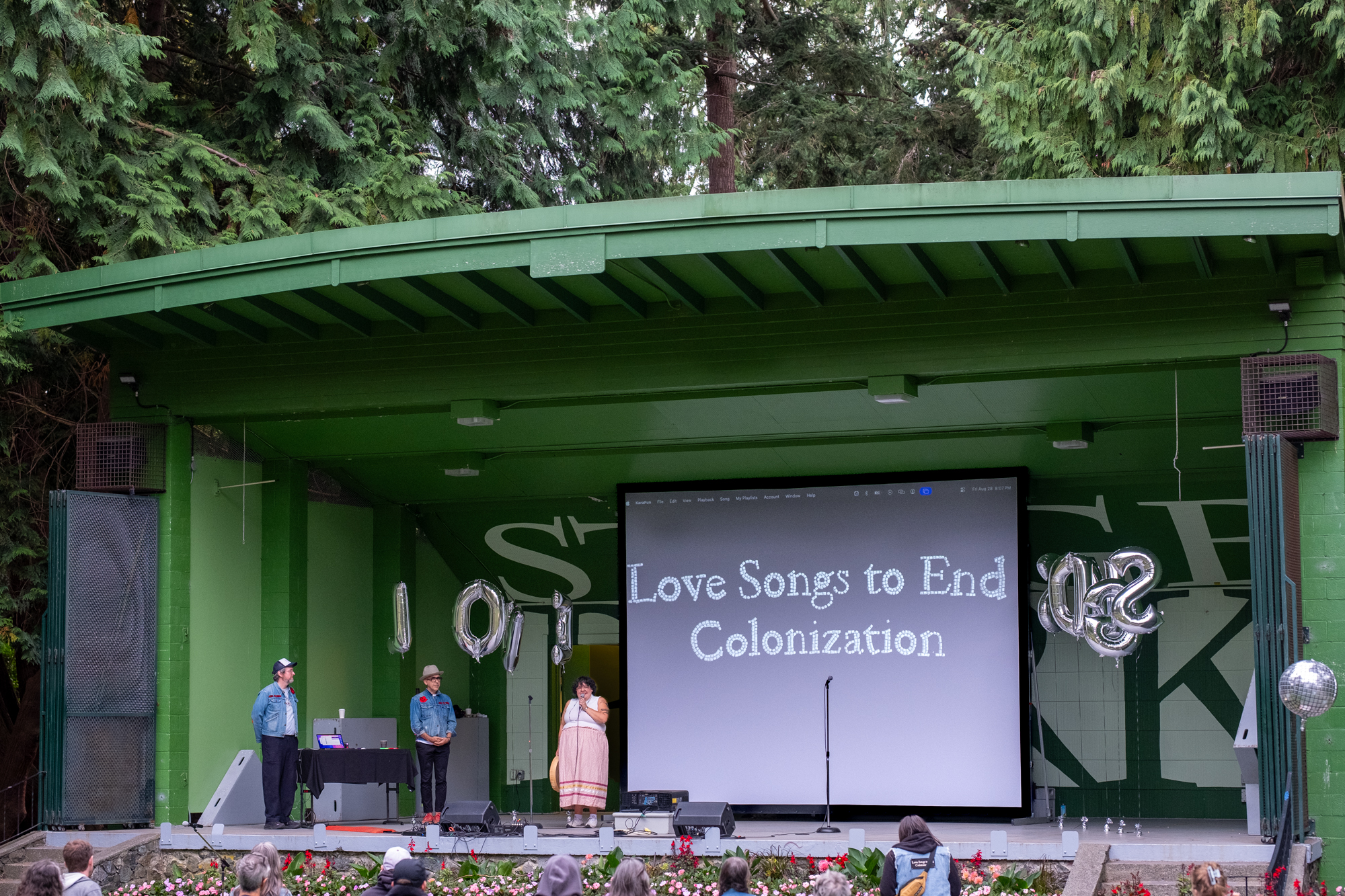
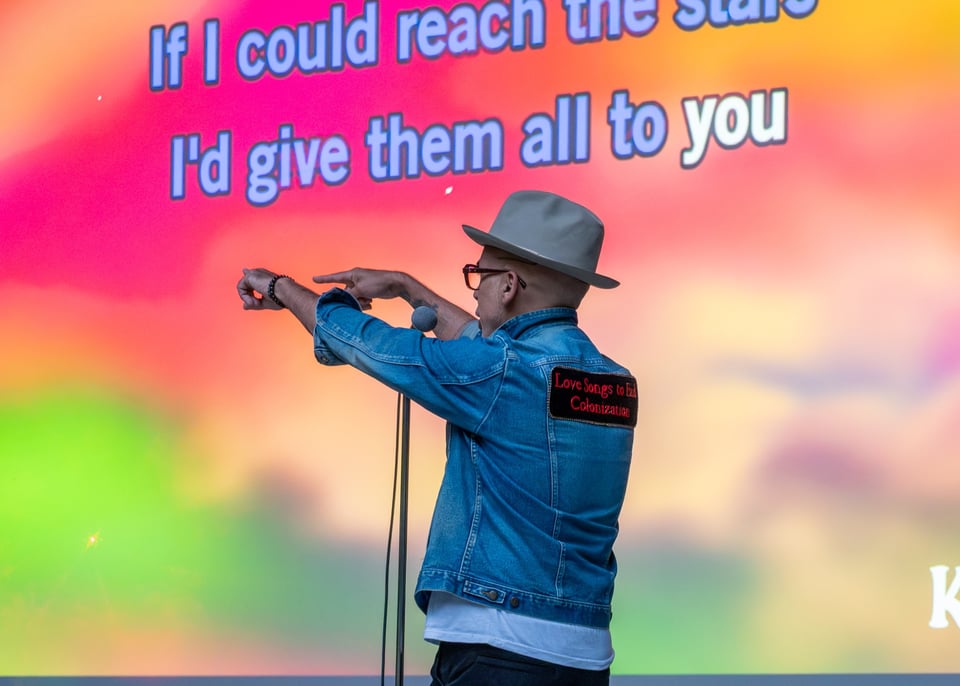
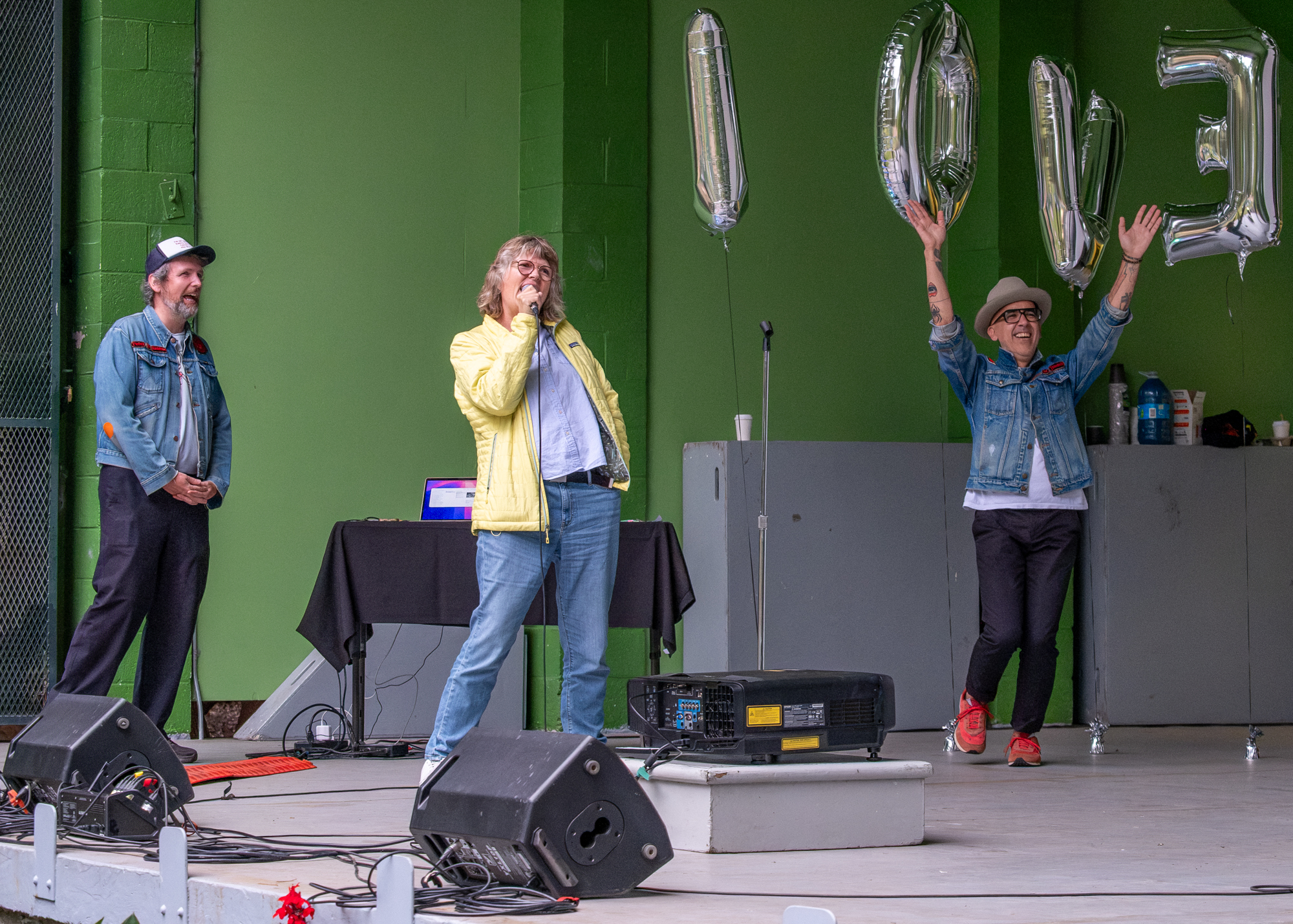
Encircled by mature cedar trees at the Cameron Bandshell, the late-summer performance began with a welcome from Songhees artist and knowledge keeper Brianna Bear. To start the performance, Morin and Kilpatrick showed the assembled crowd what a love song to end colonization is, and then people were invited to sing their own love song to end colonization. Participants successively took the stage throughout the evening, expressing varying degrees of nervousness but universal enthusiasm. Each performer was met with warm support from the artists and audience regardless of vocal chops; the project is not about technical precision but the reciprocity, energy, and engagement of singing songs to collectively address (and transform) the pain caused by colonization. Morin took time to acknowledge Shigeichi Negishi who launched karaoke in 1967 with his Sparko Box (a microphone amplifier and mixing circuit connected to an 8-track tape deck), describing how the Japanese inventor “gave a gift to the entire world, so we can step into one moment of our lives and be the stars that we actually are.”
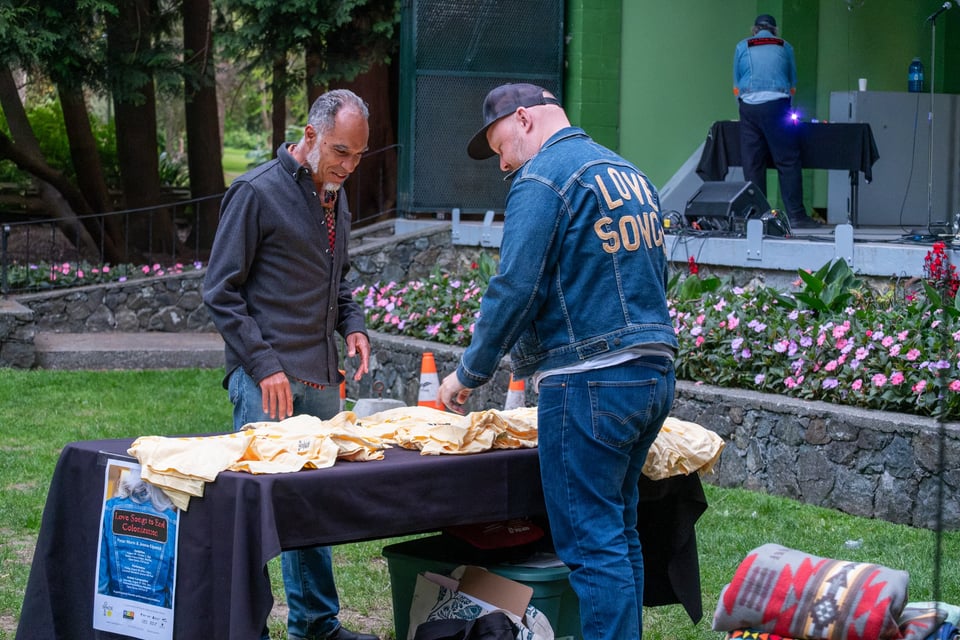
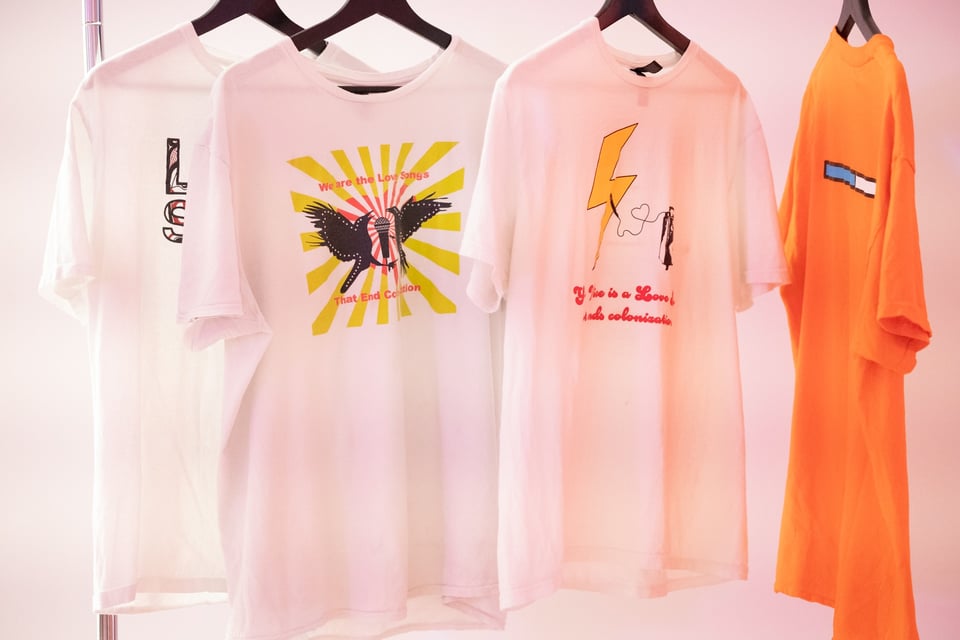
Every star that evening was gifted a “We Are the Love Songs to End Colonization” t-shirt after their song, designed by Tania Willard and presented to them by Jonsson. At the artist talk the following day, Morin discussed the greater significance of the gesture, explaining, “We’re honouring one of the important systems of these territories, a practice prioritized by Indigenous nations: the giveaway—you offer to me, I’m going to offer back as an expression of my gratitude.” This give-away as an acknowledgment of help to end colonization in Canada is also a broader gesture to these original economic systems of the land, invented by Indigenous Nations, as a way to keep the land/people going.
Another important way the project works towards its aim of dismantling colonialism is by creating conditions that allow the world to be perceived and conceived of differently. “We do try to present a framework for recontextualization,” Kilpatrick reflected at the talk. “People will sing the lyrics as they were written but the audience is actively reframing them, sort of saying ‘this is an obvious way to recontextualize them’. There are these beautiful moments where there’s a collective gasp from the crowd or a laugh or applause. It’s this group experience of rethinking things that’s so fascinating.”
This recontextualization approach has been part of Morin’s practice for a long time. In 2012, he organised a collective performance in a 19th century BC courthouse once presided over by a Chief Justice whose relationship with Indigenous peoples as a representative of the Crown is reflected in his posthumous nick name: The Hanging Judge. Morin sang The First Cut is the Deepest by Yusef Islam in this space as a challenge to the British queen. Triangulating the weight of history, the malleable lightness of pop songs and the physical presence of live singing activates a collective process of acknowledgment and healing. In considering the impossible task of defining complex systemic change in terms of a simple and specific goal, Morin offered:
“What does this decolonization actually do? What do you want to do? My decolonial efforts are about being in love with my friends, being inspired by my friends, figuring out ways to engage with the people that I love who give to me every day, and having a space to talk about these challenging ideas. I love this messy joy.”
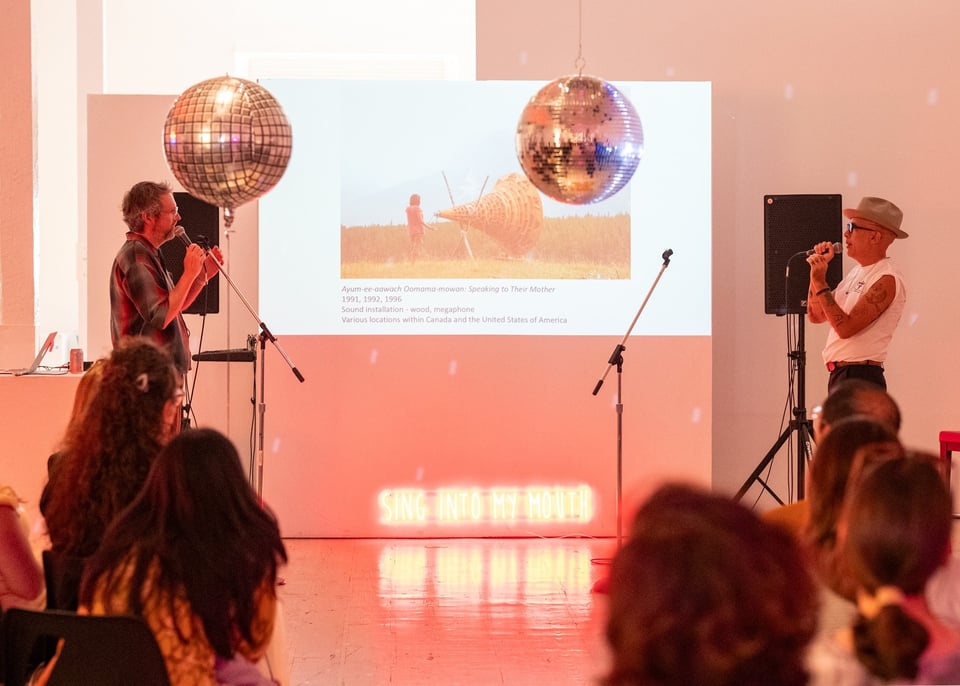
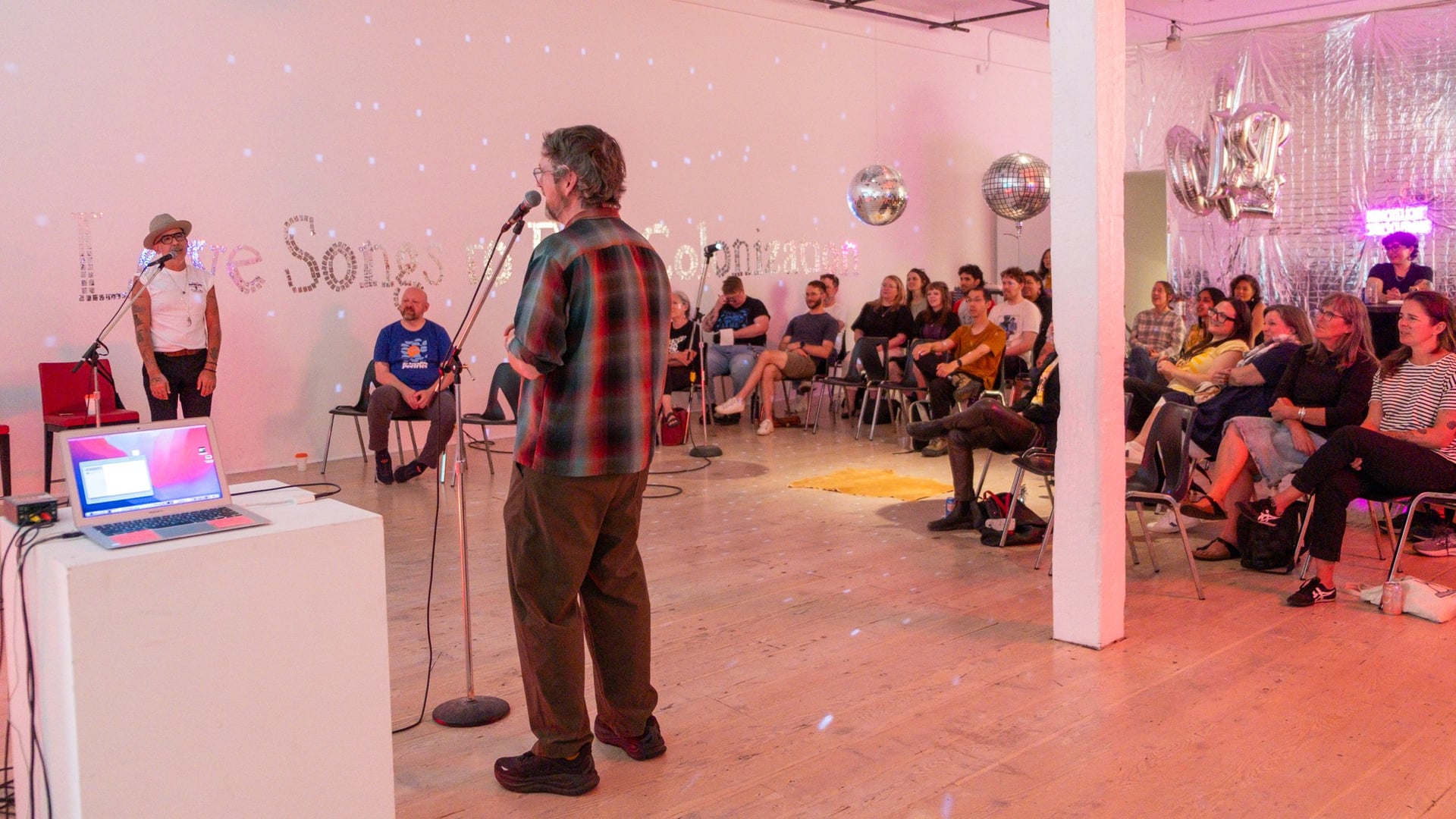
Love Songs to End Colonization does what so much important art does: it helps us to think and feel our way through an often painful but always potentially beautiful world. The related installation at Open Space, running August 28 – October 3, recreates much of the immersive, joyful atmosphere of karaoke, with disco ball sparkles, neon signs, footage of past performances, and karaoke videos produced by the artists on loop. This is all lent depth by the presence of a very small tanned hide that impressively fills the whole space with a comforting smoky smell. The music is playing and the mics are live; visitors are welcome to keep the performance going.
Feature Image: Peter Morin, Co-curator of Love Songs To End Colonization, Cameron Bandshell, August 28, 2026. Photo by Kyra Kordoski, courtesy of the AGGV.