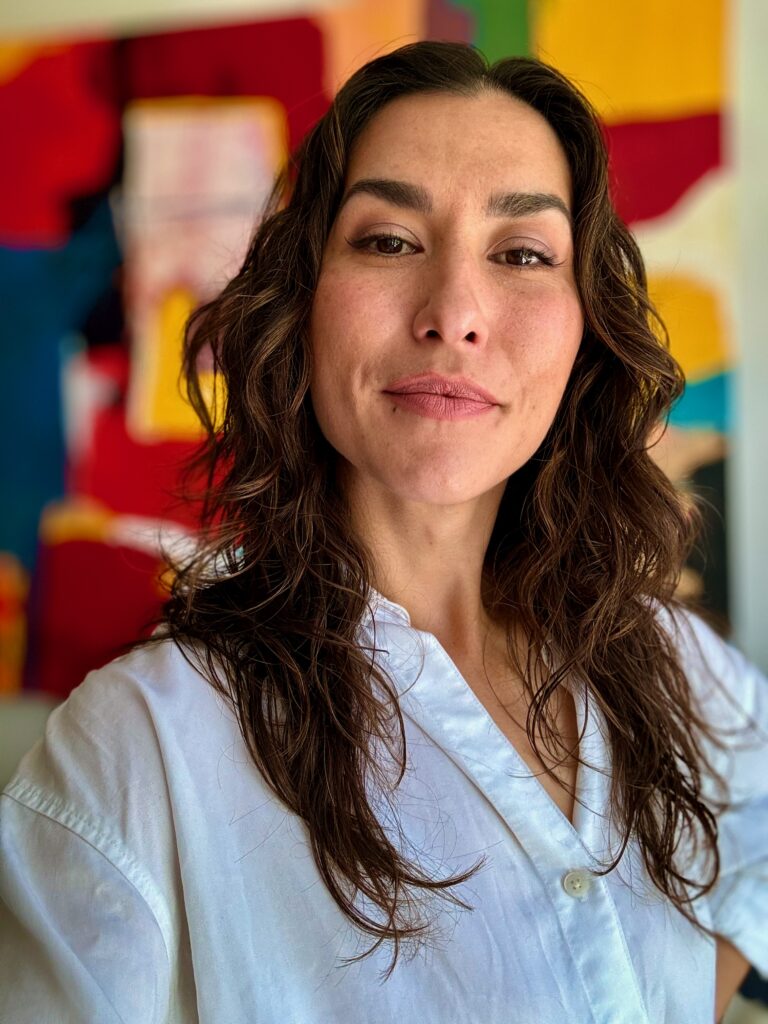
The ocean as force and metaphor for continuous change is central to Georgeson-Usher’s practice. Here, she has brought together a focused, compelling group of artists whose inquiries overlap in and at the edges of Pacific waters. Writing from Venice, where she was attending the 61st Venice Biennale with a group of her graduate curatorial students and colleague Nikki Georgopulos, Georgeson-Usher shared some beautiful insights into her life, her work, and this new curatorial presentation.
How has it been meeting the ocean in Venice?
Arriving into Venice via water has always been such a comforting moment for me. There is something about the rocking as you near the city that sets a rhythm for being there. I am very lucky to have been able to go to Venice for the opening of the Biennale di Venezia every two years for the past decade. Whenever I travel, I continue my practice as a long-distance runner and make sure that I get out for my runs every morning. Running has always been my method for visiting with place, it is a way for situating myself in a practice that I see as extremely relational. On this trip, I was reminded of just how incredible the city is. Today we fear the rise of oceans and the heating of our atmospheres which are very real concerns. But to see a city like Venice, sitting on water, moving into a future world that will experience rising oceans, I couldn’t help but think about how Venice is the future imaginary, it is that speculative world building that finds such futurism in ancient technologies. A city resting amid the vastness of the ocean is a pretty spectacular thing.
The Pacific Ocean has been a central focus of your curatorial practice. Could you tell us about that?
The ocean is so special to me, I know it intimately as I was raised on a tiny island just off the coast from the mainland of what is now known as British Columbia. There are so many things I have learned from the ocean that have created the scaffolding for who I am as a human. I have often spoken about living on Galiano Island and how deeply we are influenced by and rely on the ocean and its behaviour. From the ocean, I have learned about how it is (we are) always in a process of becoming—as oceans merge, the texture, temperature, flow, and colour of the water changes. I have long been infatuated by the ongoing, never-ending way in which the ocean is always flowing into its next state, how water is always moving to its next manifestation. For me, there is something peaceful in that lack of stasis.
In my work as a curator, I have often brought the ocean in. Sometimes through poetic metaphor and sometimes in direct reference to the geographical specificities around a shoreline. For example, in my recent exhibition at the Vancouver Art Gallery, one of my favourite moments was in our highwall gallery in the central stairwell. In that tall space I worked with the metaphor of a whirlpool and what I have learned about getting stuck in one. The teaching of the whirlpool is to do your best not to panic, to try to swim on a slight diagonal towards the outside and not to swim directly out of it as you will tire yourself out. But failing your ability to swim on an angle out of the whirlpool, all you can do is allow your body to be pulled down and trust that it will spit you back out. I employed this metaphor onto thinking about the ways in which Indigenous knowledge was suppressed—forced in a direction—by colonialism, but that instead of fighting against this force directly we need to be strategic and to trust that we will come out on the other side. This also spoke to the theorizations of Fred Moten on the undercommons, where I started to consider it in line with an undercurrent and to the work of Saidiya Hartman’s writing on the afterlife of slavery.
Could you talk a little about each artist and what drew you to them for this theme?
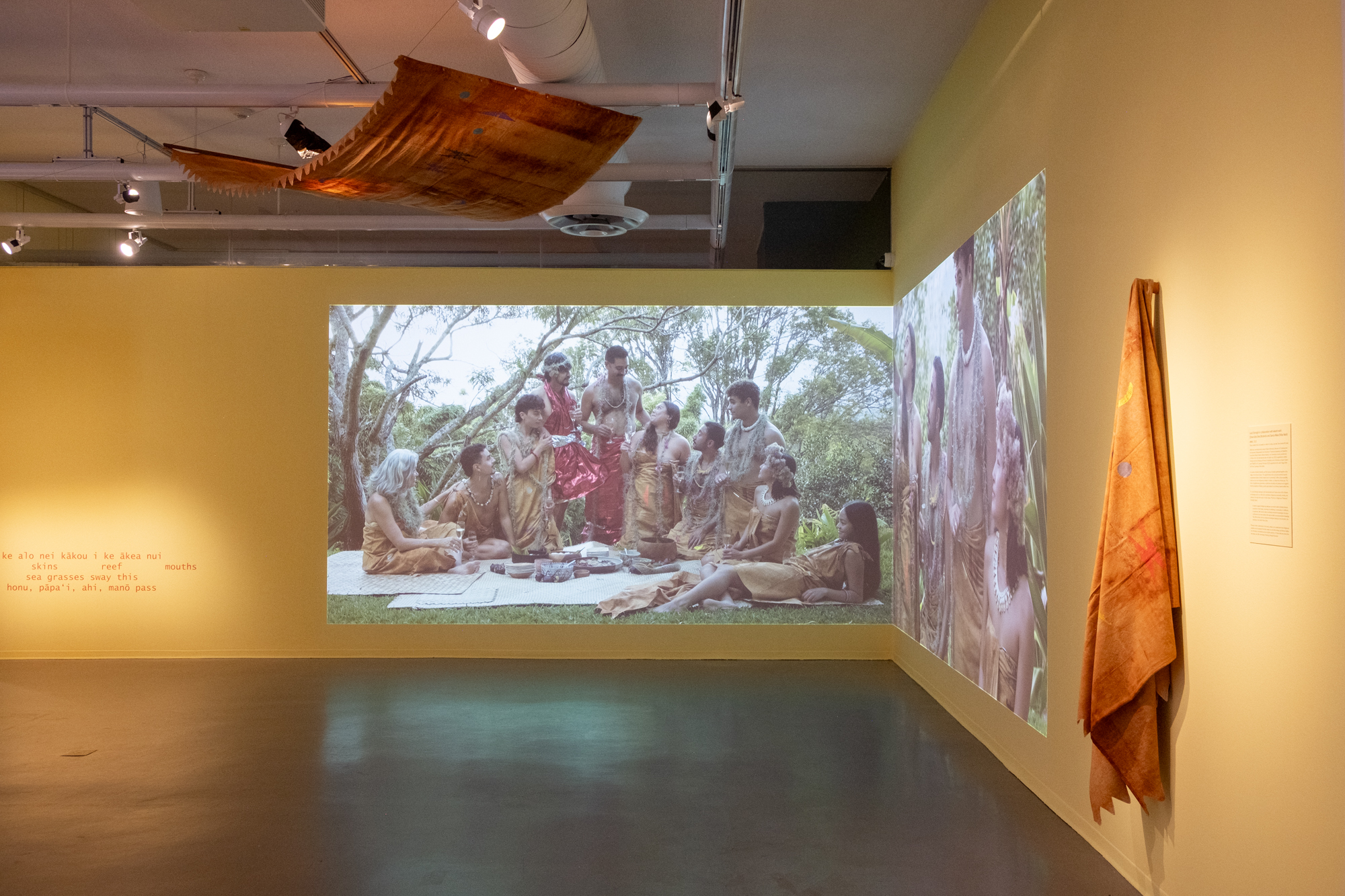
The starting point for this exhibition was engaging with afiafi, a piece by Léuli Eshrāghi with kekahi wahi (Drew Kahu’āina Broderick and Sancia Miala Shiba Nash). I was particularly enamoured with the intimate way in which this work shows intergenerational Indigenous love, privileging the leisure and luxury of Indigenous bodies. In a nod to Indigenous futurism, this work pushes us towards an unapologetic understanding of how Indigenous peoples deserve the ability to rest, to have moments of being pampered and extremely cared for—and more than this, that seeing Indigenous bodies in these moments of rest and relaxation and joy in being together should not be shocking. It should be the baseline measurement of how we deserve to live.
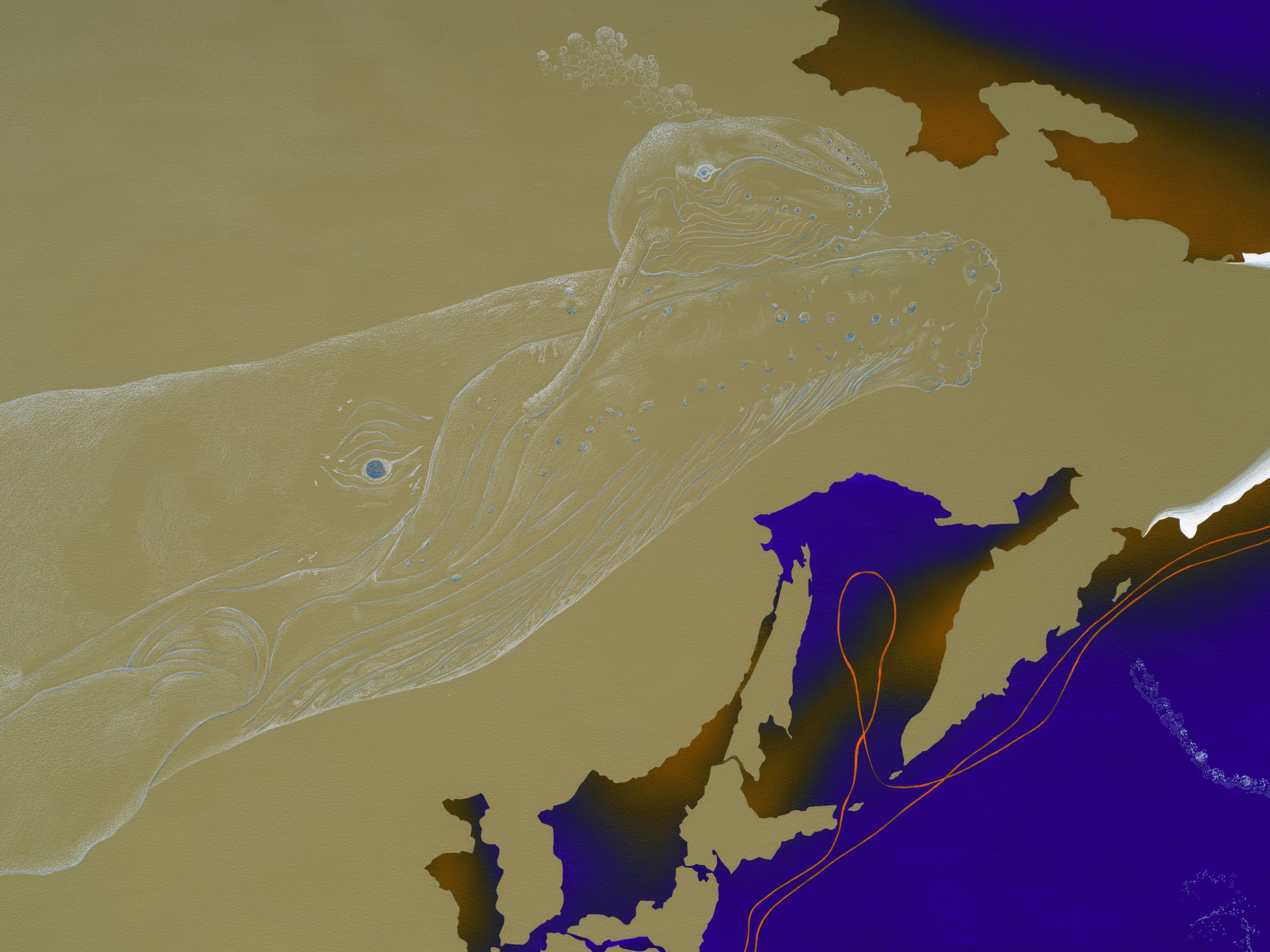
From this, I wanted to think about this idea of togetherness through the work of Carolina Caycedo. I became infatuated with the collaborative project she undertook as part of Spiral for Shared Dreams which was installed at MoMA in 2024. These works are such a delicate engagement with communities who are deeply indebted and invested in life at the edge of the ocean. For this exhibition in Victoria, I wanted to think alongside Carolina’s work within this troubling of oceanic joy and collectivity because her work adds such beautiful and tender levels of complexity. With the tracing of the whale’s movements in Our Blue Corridors, we see the supreme joy of whales moving through their ocean worlds, we see how humans celebrate whales, but we also see how humans simultaneously bring such devastation. I love how this work brings forward a complexity to a tender path of whales.
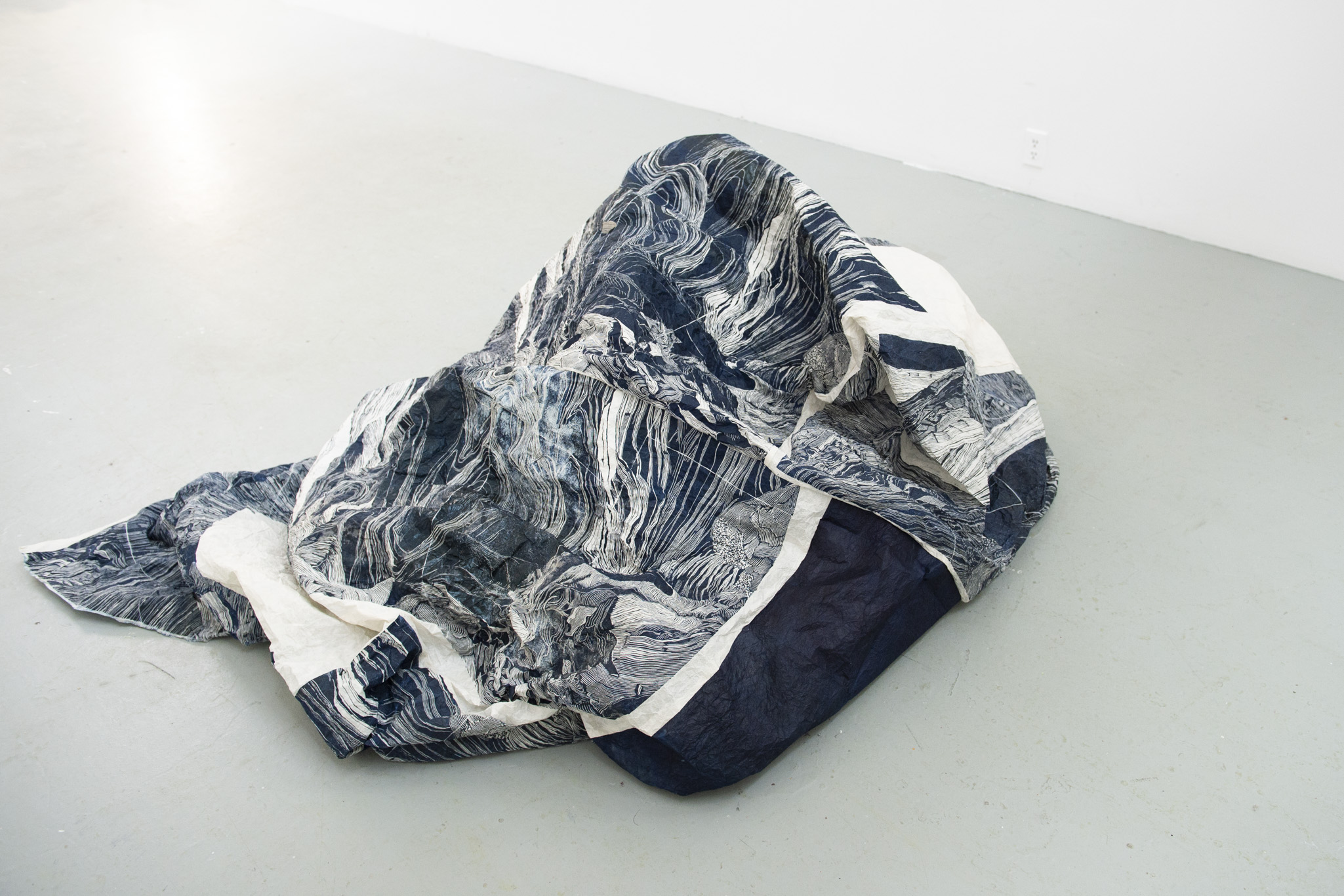
Alexa Hatanaka’s print-based work firstly has such a magnetic energy to it, but beyond that, I have known Alexa for over a decade now and have loved seeing the way that she thinks deeply and poetically with the land. The lines and patterns in her prints speak to this relationship with water through the form of ice that has been chiseled by the wind bringing a dynamic form of movement. The prints are placed on collaboratively produced washi paper which adds another beautiful layer of texture and delicacy. She has often spoken about the role of mental health and joy in her work. I love how these elements come into the work in gentle ways that find resonance in the materiality as well.
This subtlety was tied together for me with Violet Johnson’s process of creating her pieces that speak to family, memory, ancestral territory, and of course, water. Violet and I talked a lot as she built her water grams, she told me stories of the memories she has of growing up, of those she has lost, and of a trip her and her mother took to collect water around her family’s territory. Her pieces are deeply emotional, but within layers of sadness and reminiscence are moments of joy—one that stood out was of her mother painting contently at the beach while she collected water samples for her work.
I found so much resonance with how Violet was speaking about water and memory and family with Charles Campbell’s recordings of breath. Charles’ work speaks to memory, often painful memories of the Atlantic slave trade and the loss held in the middle passage, through the beautiful visualization of breath from Black community members. I remember sitting in the dark space of the the Powerplant in Toronto looking at the shadows of How many colours has the sea (2024), which was a structure suspended from the ceiling that gives shape to underwater terrain. I sat there, watching these shadows interact with people moving around the room while listening to Charles’ guided meditation. It was such an impactful moment that allowed me to hold memory of my grandmother who I had just recently lost. Through Charles’ work I think about how our collective breath holds these memories, some memories being good, some horrific, but that some of the weight shifts when things are held together.
In terms of facilitating change and collective work towards justice, how do you see joy sitting or working with anger, an emotion that’s maybe more often associated with protest?
One aspect of this show I really wanted to think about was that in order to fully understand joy we must, too, find its opposite. I wanted to find visual language for holding all of that complexity at the same time and I think each of the artists have brought such tender dialogue to this query around joy being read through a relationship to water, or to the ocean. I have always found resonance, or fortitude, in the counter protest, or the anti-protest. That the simplicity of centering Indigenous and Black joy despite the insurmountable depths of trauma across our histories is a form of protest. If we come back to the metaphor of the whirlpool or a riptide, the teaching of how to swim out of it is compelling here. Again, if we are to swim directly against the push of currents, we will tire ourselves out and fail. But if we are strategic with our energy and our focus, we will emerge on the other side. There is so much power in that. We do have so much to be justifiably angry about through this ongoing poisoning of colonization, yet how special is it to see folks in our communities shining with such beautiful, joyous light despite the horror?
Are there any personal joyful ocean memories you would be open to sharing?
Here are some things that instill joy for me at the edge of the ocean:
My dog scurrying along rocky beaches looking for her next adventure
Barnacles opening and closing
The sun’s gradual dance towards the horizon
Bats skimming just above the surface of water eating bugs
Eating chips with my family at the beach as we talk about life and tell stories
Standing on the dock listening to water move against the sides of boats and buoys
Listening to Otis Redding’s “The Dock of the Bay”
Waving to seals every time they pop their heads out of the water
Remembering the freedom in dancing at the edges of water
Watching ripples or wakes in water slowly dissipate and fade away
As waters merge – swaying waves beckoning us closer runs from June 6 to October 4, 2026.
Georgeson-Usher has been supported on this project by Jazmine (Ts̓ qáxa7) Andrew, a Lil̓wat / St’át’imc / Sinhalese curatorial assistant, undergraduate student, and artist from Mount Currie, BC.
Feature Image: Courtesy of Camille Georgeson-Usher