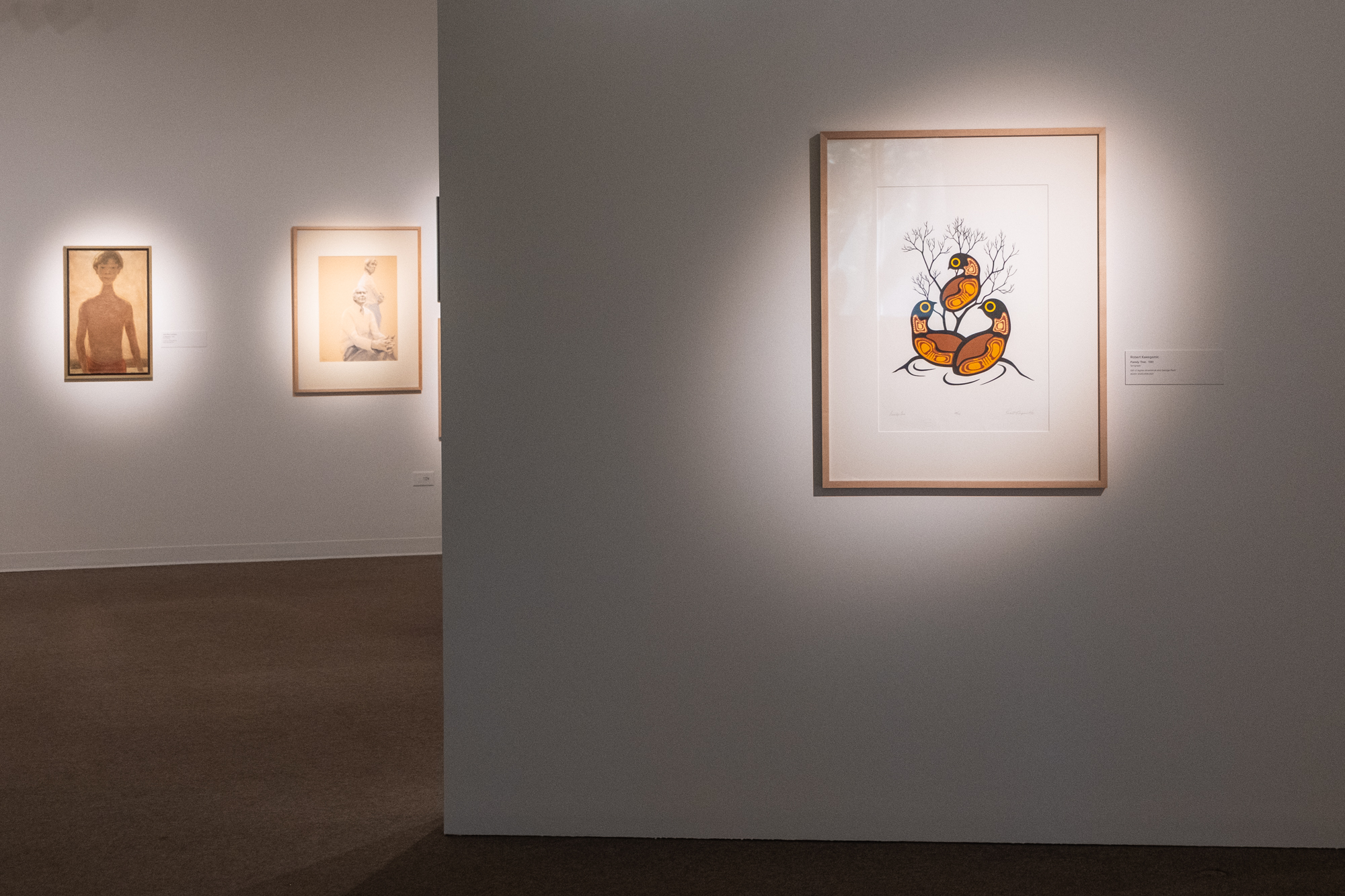
On stepping into the exhibition, visitors are welcomed by Anishnaabe artist Robert Kakegamic’s Family Tree (1981), a serigraph featuring three grouse. Two adult birds are grouped protectively around a younger one, emphasizing immediately that care and connection are not exclusive to human relationships. Kakegamic’s own family tree encompasses the Triple K Co-operative that was founded in Red Lake, Ontario by brothers Joshim, Henry, and Goyce Kakegamic. With a mandate to support Indigenous artistic self-representation, they produced high-quality prints for many artists including members of the philosophically aligned Professional Native Indian Artists Incorporation (PNIAI), informally known as The Indian Group of Seven. Illustrating the connective roots running through our collection, Family Visits also features two prints by PNIAI artists: Jackson Beardy’s Loon and Fish (1947) and Eddy Cobiness’ Porcupine Mother (1979).
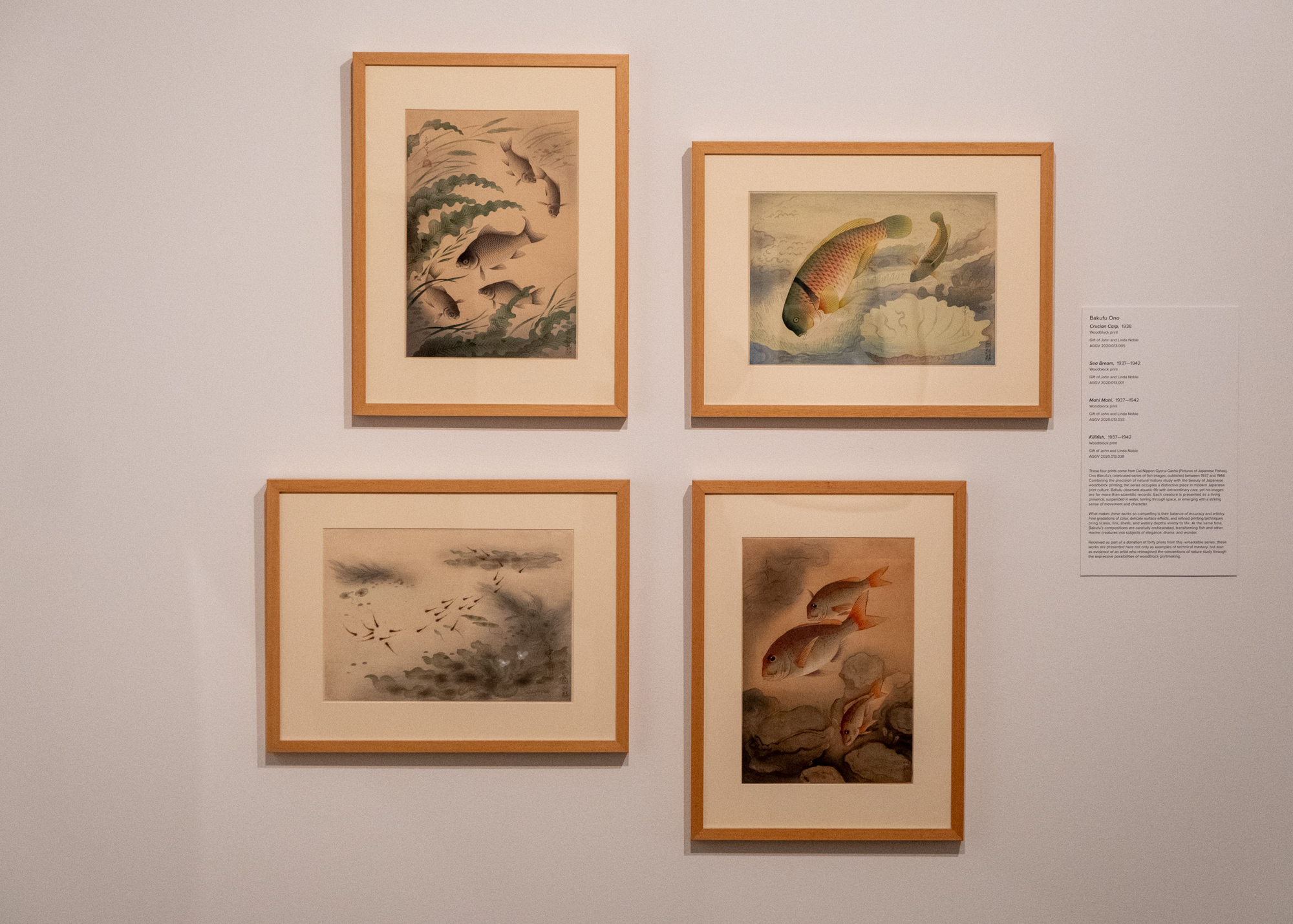
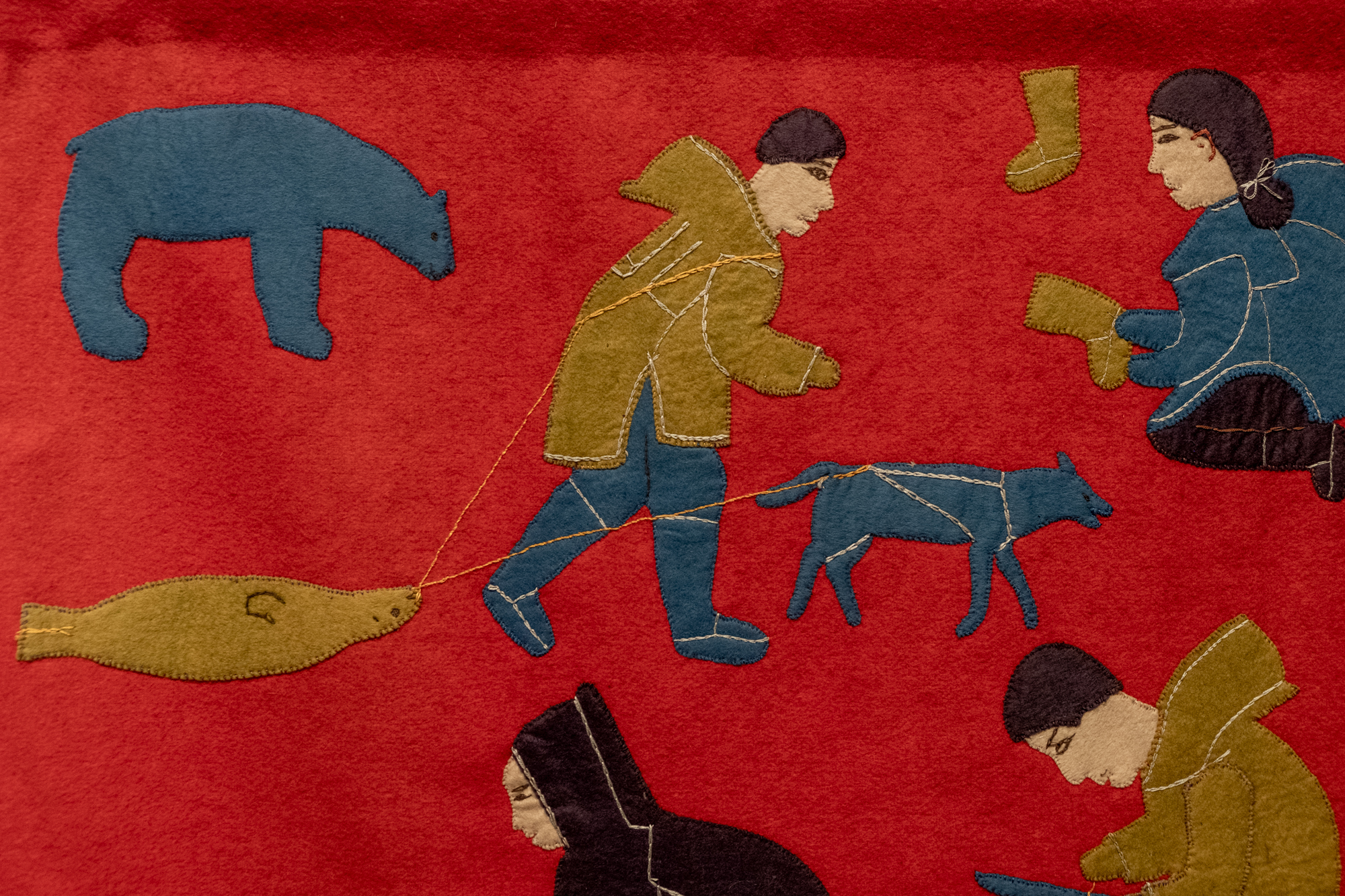
The expansive perspective on relationships continues throughout the exhibition. Four works from Japanese ukiyo-e printmaker Bakufo Ono’s celebrated series “Dai Nippon Gyorui Gshū (Pictures of Japanese Fish, 1937-1944)” are meticulously rendered while conveying movement and interactions between pairs and schools of fish. The artist’s care for his subjects led him to spend considerable time underwater, observing them from a submersible. An ink and chalk drawing by Jack Shadbolt, almost abstract at first glance, reveals several birds snuggled into rock formations that were inspired by the ocean-carved shores of Gabriola (Birds on the Rock Caves, 1954). Felt wall hangings by Salome Kalaaserk and Arene Avaalaqiaq Tiktaalaaq present rich and balanced integrations of human and animal lives, depicting scenes of hunting and travelling with sled dogs; these are presented alongside pastoral oil paintings of domesticated grazing cows, and shepherds with their sheep.
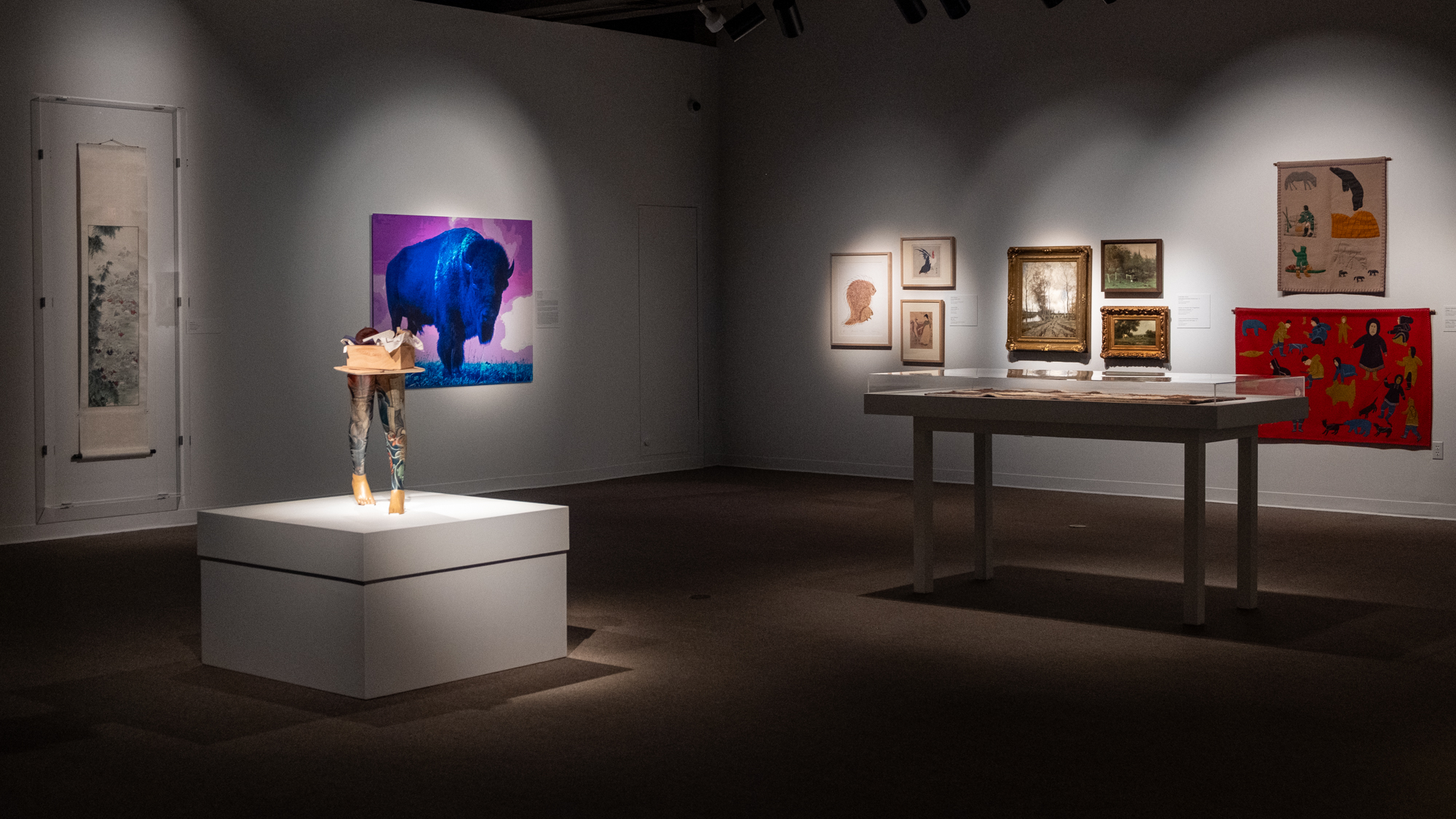
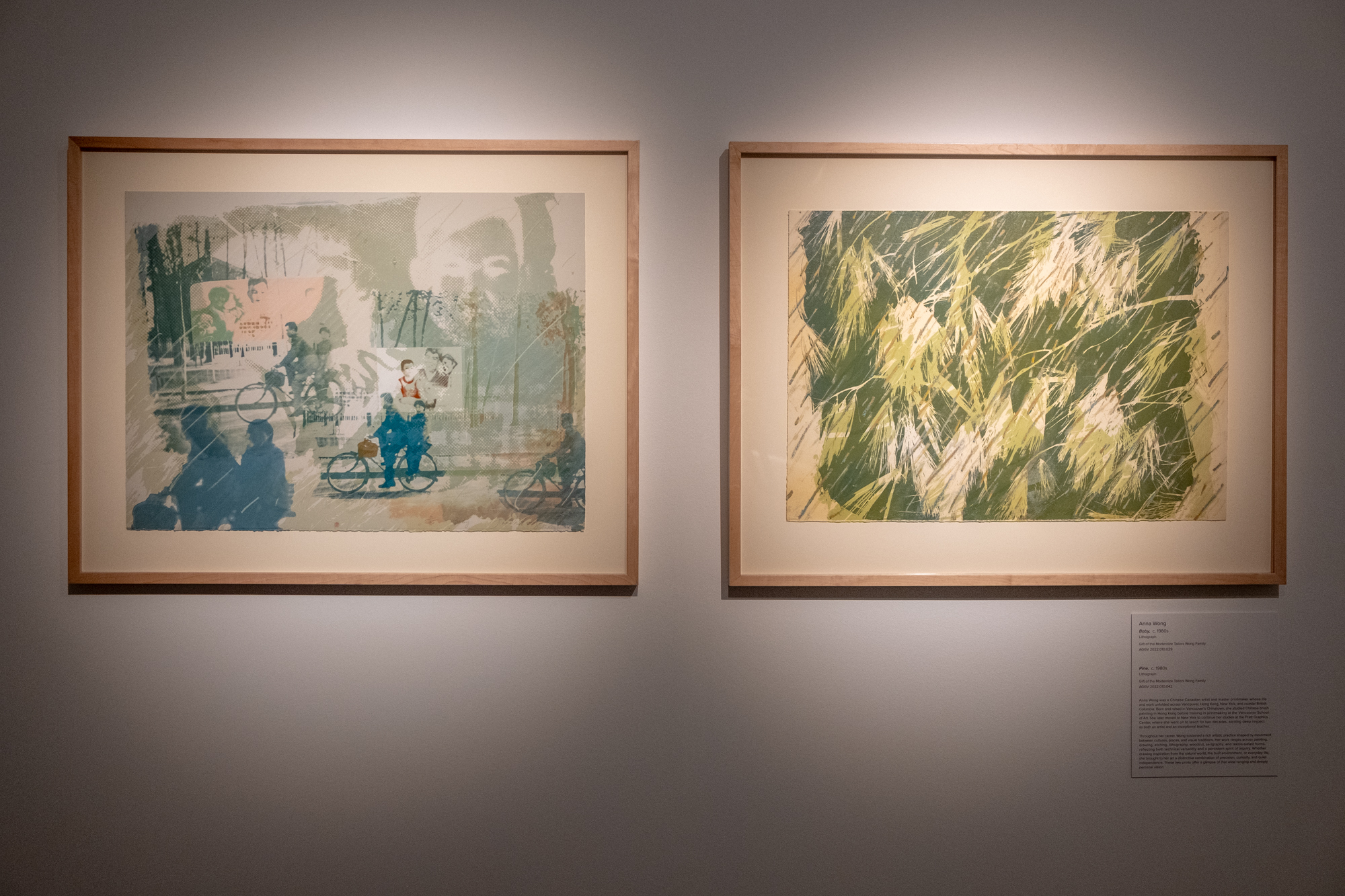
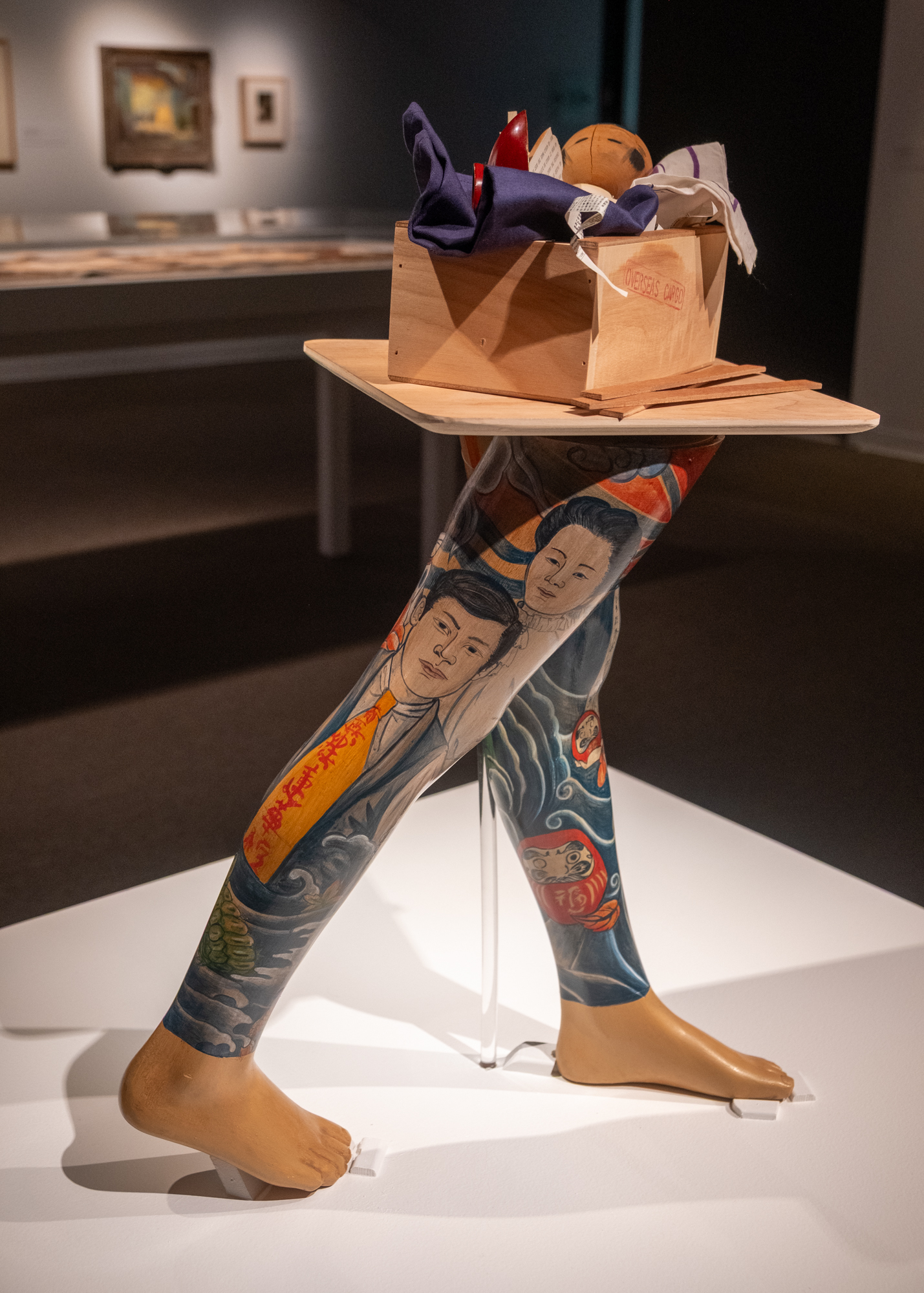
Two lithographs by Chinese-Canadian artist Anne Wong are included: Baby (C. 1980s), a collage-like composition of families cycling with children through semi-urban streets; and Pine (C. 1980s), a focused depiction of tree boughs—an example of plant families. These offer, in their pairing, a meditation on the environments we move through with, for, or away from kin, often in transition from rural to urban lives. The theme of global movement is also taken up in Haruko Okano’s 1993 sculpture, Passing Through. A third-generation Japanese-Canadian, the artist asked her community to suggest materials for the piece. Okano’s small box of gifted tokens is carried by mannequin legs that feature a portrait of her grandparents, who emigrated from Japan due to famine at the beginning of the 20th century. Her work prompts reflection on how materials and objects can bind culture, community, and family together as we disperse geographically.
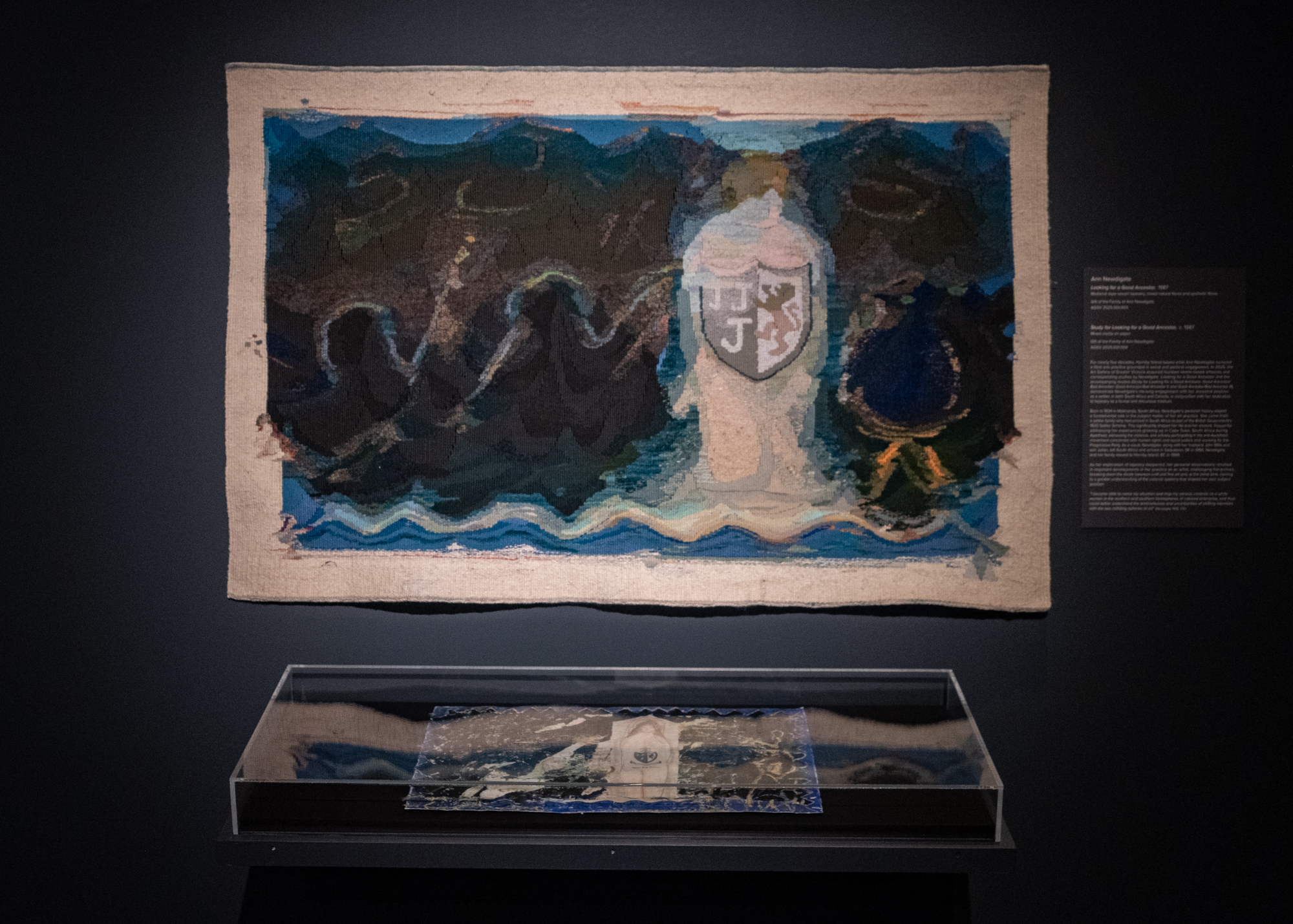
In considering materiality, a geometric weaving of wool with vegetable dyes by Elisabeth Herrling, who worked as one of the last fluent speakers to preserve her Halq’eméylem language—a Salish dialect distinct to the Stó:lō people—sits in close proximity to Cowichan artist lessLIE’s serigraph Spinning Whorl(d) (2018). Salish spindle whorls, used to spin fibres for textiles, have long been adorned with carved designs that emphasize their social and spiritual significance. The expansion of this artform to prints, taken up by many Salish artists, reflects the resilience and fluidity of culture through time and technological changes. Hornby Island-based artist Ann Newdigate’s tapestry Looking for a Good Ancestor (1987) features a near-impressionistic rendering of medieval European motifs. Through her weaving, she reflects on being part of a family that benefited directly from the British Government’s 1820 South African Settler Scheme and, later in life, her position as a settler within Canada, addressing complicated themes of home in relation to place and ancestral memory.
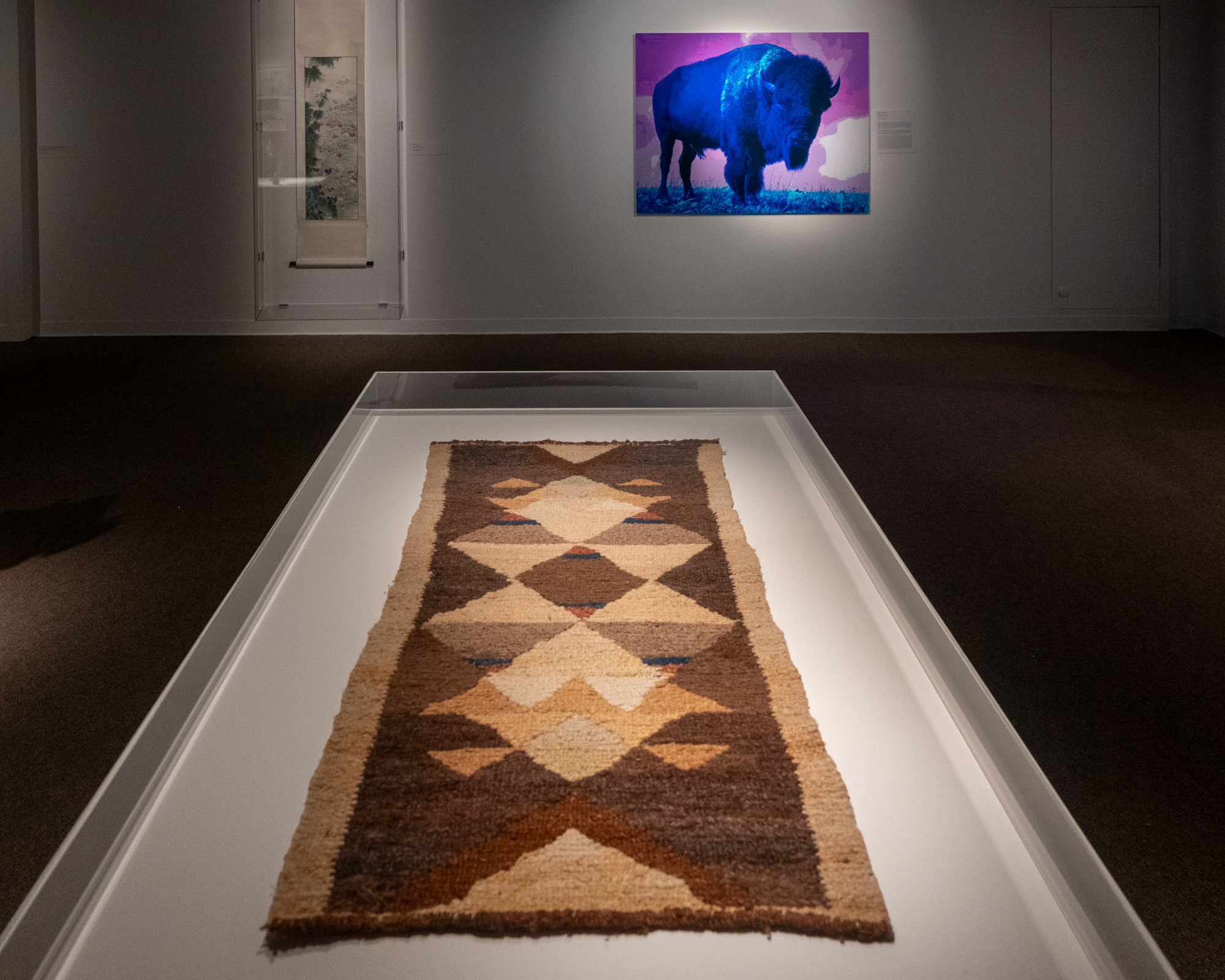
Dana Claxon’s Tatanka 2 (2019), a large, vibrant light-jet print of a bison is a powerful presence within the exhibition. Bison, commonly known as buffalo throughout North America, are called tatanka (thathánka) by the Lakota Sioux and considered sacred relatives who are vital to subsistence. The impact of Tatanka 2 is amplified by its dramatic lighting and hyperreal colours; the work is a companion piece to Claxon’s “Indian Candy” series that interrogates fetishization and commodification of Indigenous cultures. The bison’s gaze remains steady through potential perceptual distortions though, directly meeting viewers’ eyes from across the gallery. In the context of the many entanglements of Family Visits, this enacts a moving, more-than-human encounter that might focus us on the connections we have and responsibilities we owe, not just to our immediate genetic relations, but to the vast tapestry of beings with whom we share this world.
Family Visits runs from May 9 – September 6, 2027.
Feature Image: Installation view of Family Visits. Photo by Kyra Kordoski, courtesy of the AGGV.