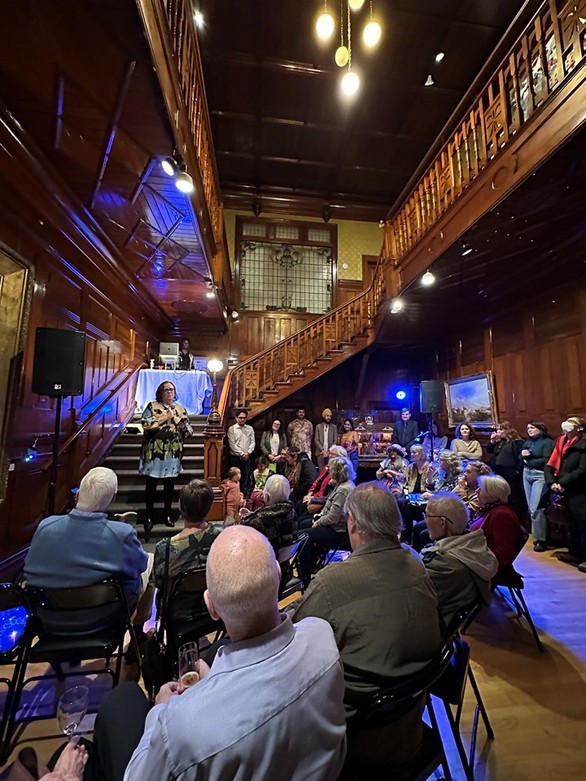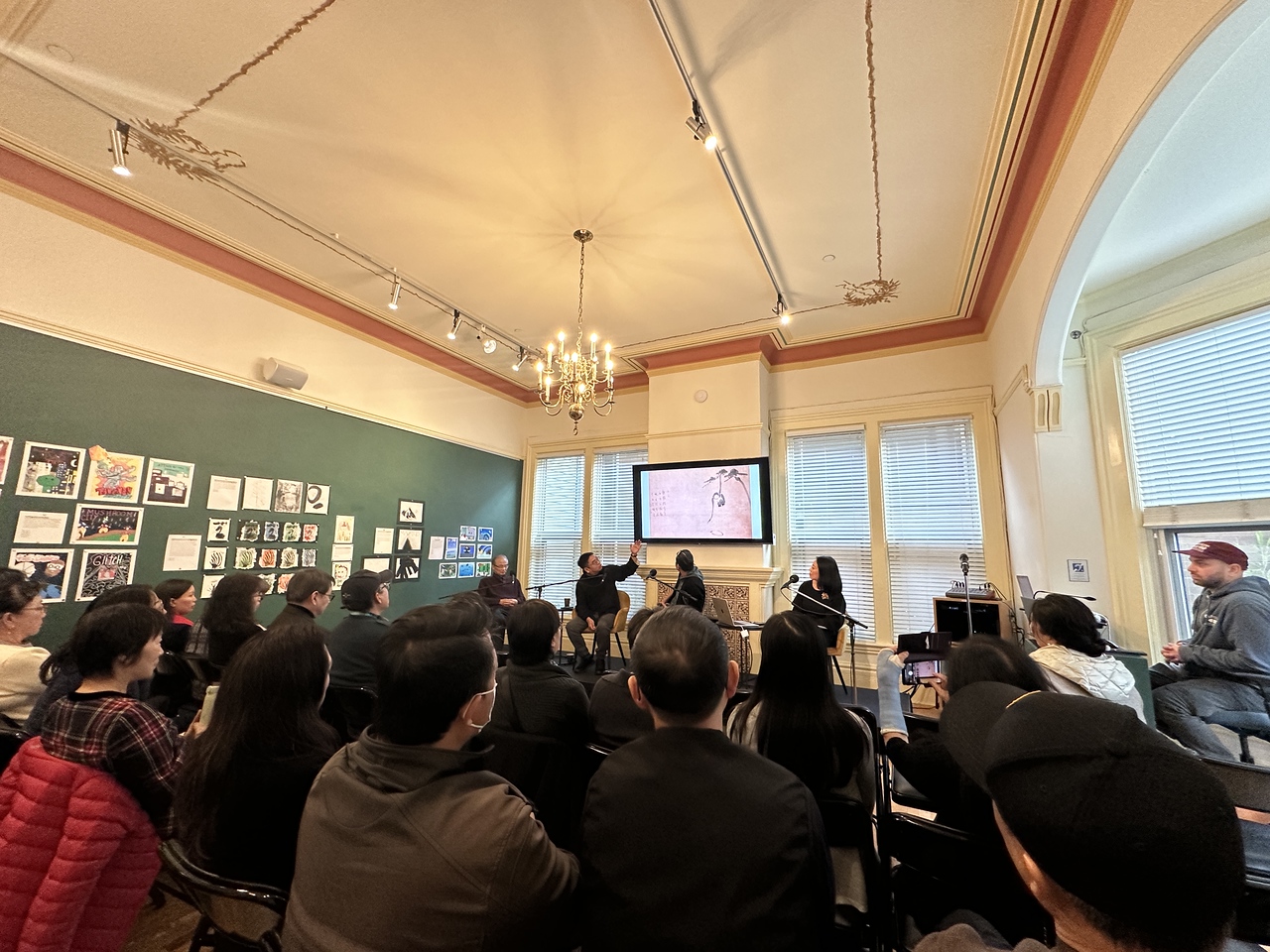
Recently, at the invitation of the Art Gallery of Greater Victoria (AGGV), I attended the opening of the exhibition Fifty Shades of Ink: Ink Paintings from the AGGV Collection. Curated by Dr. Heng Wu, Curator of Asian Art at the AGGV, the exhibition draws upon the Gallery’s permanent collection to explore the expressive capacities and historical depth of ink painting across different periods and cultural contexts. Through Dr. Wu’s carefully considered selection of works, the exhibition presents a distinctive and compelling vision of ink art within a contemporary North American gallery setting.
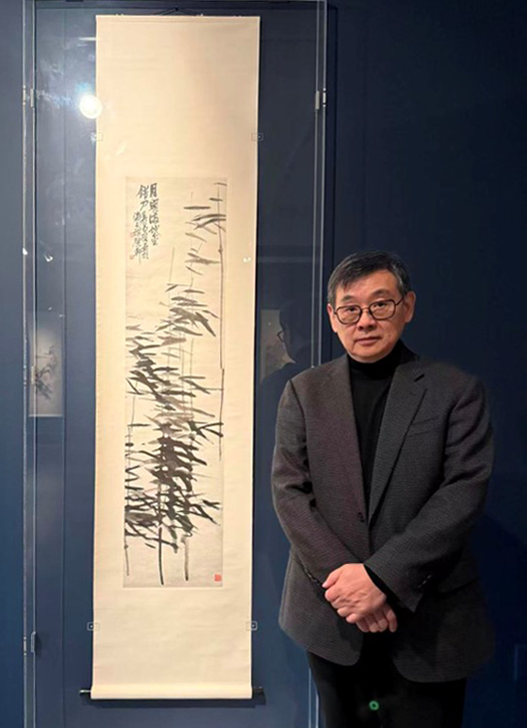
Among the works on view, a vertical hanging scroll depicting bamboo in ink particularly captured my attention. Painted by Wu Changshuo (1844–1927), the work is characterized by a strong vertical thrust, dense brushwork, and a resonant, monumental atmosphere. Rather than focusing on the external likeness of bamboo, the artist employs the motif as a vehicle for self-expression, using brush and ink to convey an inner spiritual and moral force. The work clearly privileges “writing” over “drawing,” exemplifying the core literati principle of painting as an extension of calligraphy.
From a compositional perspective, the bamboo stalks are not positioned centrally or rendered in a strictly upright manner but instead appear slightly offset. The leaves are densely concentrated in the middle and lower sections of the composition, while the upper portion is left largely open. This deliberate departure from naturalistic balance generates a visual tension best described as one of “downward weight and upward lift.” [KN1.1][MC1.2]The lower section conveys solidity and rootedness, while the expanses of empty space above function as a site for the circulation of qi [KN2.1](vital energy). Through this asymmetry, the painting achieves stability not through equilibrium, but through controlled structural tension, demonstrating the artist’s command of overall momentum.
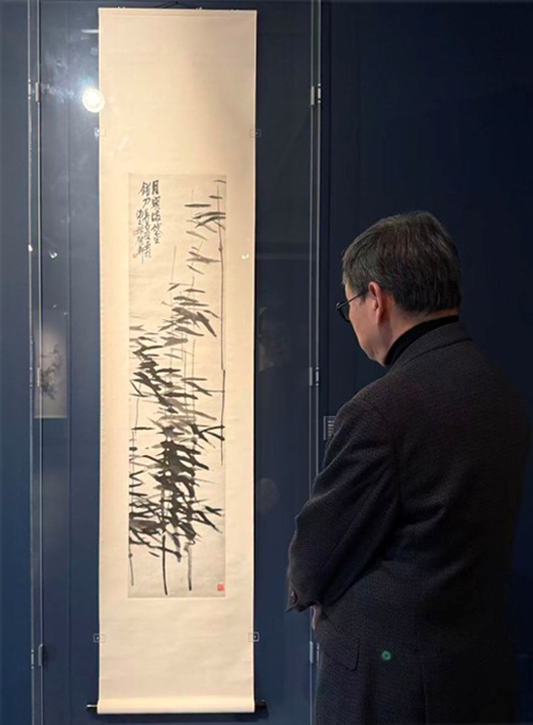
Brushwork constitutes the expressive core of the painting. The bamboo stalks are executed primarily with centred brush strokes, their lines slightly resistant and unpolished, alternating between dry and saturated ink. This treatment imparts a pronounced jinshi (epigraphic, bronze-and-stone) quality. The bamboo leaves, by contrast, are rendered with swift, forceful strokes that intersect and overlap dynamically. Rather than pursuing clearly articulated spatial layers, the leaves establish an internal order through rhythm, direction, and variation in pressure, unfolding across the surface in a manner reminiscent of cursive script. What may initially appear spontaneous or even disorderly is, in fact, grounded in rigorous calligraphic discipline and a high degree of artistic self-awareness.
The inscription is positioned along the upper portion of the scroll, functioning not as an explanatory caption but as a structural and conceptual counterweight to the image. Poetic in tone and restrained in expression, the inscription contrasts with the visual density and gravity of the ink below, creating a productive tension that enriches the work’s spiritual dimension. In this interplay, poetry elevates the spirit while painting establishes its structural foundation, reflecting the interdependent relationship among poetry, calligraphy, and painting that defines the literati artistic tradition.
Overall, this bamboo painting does not depict bamboo as a natural object, but rather as an embodiment of character. It eschews elegance and lyrical refinement in favor of resilience, composure, and inner strength. Embracing awkwardness as a form of sophistication and weight as an aesthetic value, the work reveals a depth of artistic cultivation and spiritual intensity that rewards sustained contemplation.
Such curatorial practices also offer a constructive model for the continued presentation and interpretation of Chinese ink painting within the North American cultural context.
Fifty Shades of Ink: Ink Paintings from the AGGV Collection runs until April 26, 2026
LEARN MORE
Feature Image: Courtesy of He Xiang (Shawn Xiang He)